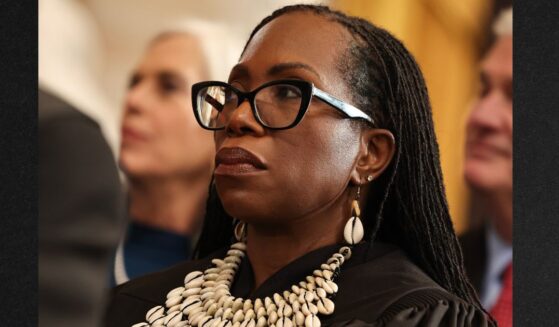
Ketanji Brown Jackson Makes Up Her Own Doctrine About 'Experts' in Bizarre Tangent During Supreme Court Oral Arguments

Supreme Court Justice Ketanji Brown Jackson has a college sophomore’s understanding of the Constitution.
That is no exaggeration. In fact, it might understate the case. I have taught college sophomores whose knowledge of the Constitution’s basic principles far exceeds that of Jackson.
During oral arguments Monday in a case involving fired Federal Trade Commissioner Rebecca Slaughter, Jackson peddled two grotesque lies, one of which showcased her own unconstitutional doctrine regarding so-called “experts” in the federal bureaucracy.
President Donald Trump fired Slaughter in March. Slaughter responded by suing the president, claiming that SCOTUS’ decision in the 1935 Humphrey’s Executor case prevents the elected chief executive from firing the unelected heads of agencies without cause.
On the whole, SCOTUS appeared hostile Monday to the idea that federal bureaucrats exist independent of the elected president’s will. That bodes well for Trump, the Constitution, liberty, and self-government.
Jackson, of course, generally plays fast and loose with the Constitution. On occasion, in fact, she has reportedly annoyed even her fellow liberal justices, Elena Kagan and Sonia Sotomayor.
On Monday, Jackson made her dubious claims during a back-and-forth with Slaughter’s attorney, Amit Agarwal.
Her first lie involved the place of “experts” in the constitutional order.
“Presidents have accepted,” she said, sounding eager to interrupt Agarwal and make his point for him, “that there could be both an understanding of Congress and the presidency that it is in the best interests of the American people to have certain kinds of issues handled by experts.”
Imagine speaking those words at the Constitutional Convention in 1787. How might the revolutionaries present there have responded to the attempted imposition of an aristocracy of “experts”?
Alas, Jackson’s second lie came moments later, when she described the federal bureaucracy as “non-partisan.”
After nearly 10 years of deep-state attacks on Trump, does anyone seriously regard the federal agencies as non-partisan?
If they do, perhaps Washington, D.C.’s comparative affluence and liberal voting patterns will persuade them otherwise.
Either way, legal experts and others on the social media platform X marveled at Jackson’s ignorance.
Jonathan Turley, for instance, called her argument “a virtual invitation for a technocracy rather than a democracy.”
As is increasingly becoming the case, Justice Ketanji Brown Jackson stole the show yesterday in oral argument, suggesting experts should not be subject to termination by a president. It is a virtual invitation for a technocracy rather than a democracy…https://t.co/Fm3MOUaqHo
— Jonathan Turley (@JonathanTurley) December 9, 2025
Meanwhile, legal analyst Phil Holloway correctly noted that “experts” have no constitutional standing.
Ketanji is wrong
The Constitution doesn’t say a damn thing about a shred of government power being vested in any such of TheExperts™
It doesn’t even require Supreme Court Justices to be lawyers
It DOES vest massive power in one person: The President of The United States https://t.co/RQjX3JpkZh
— Phil Holloway ✈️ (@PhilHollowayEsq) December 9, 2025
Other X users mocked the idea of non-partisanship.
“Experts” like Fauci or those in the American Medical Association who told us men can get pregnant?
No thanks.
I don’t trust any of the liberal “experts” because they are partisan frauds and liars.
— Pro America Politics (@Pro__Trading) December 8, 2025
In short, We the People created the Constitution, which created the co-equal legislative, executive, and judicial branches. Nowhere did We the People create a fourth branch of “experts.”
Thus, concerning sovereignty, the pecking order goes as follows: the People, the Constitution, and the three branches of the federal government.
By Jackson’s elementary reasoning, however, the “experts,” whom the Constitution does not mention, somehow stand above the president, whom the sovereign People elected. One could scarcely imagine a more sophomoric or tyrannical understanding of constitutional self-government.
Truth and Accuracy
We are committed to truth and accuracy in all of our journalism. Read our editorial standards.
Advertise with The Western Journal and reach millions of highly engaged readers, while supporting our work. Advertise Today.