My Brother's Teacher Told Him to 'Draw What Brings You Most Joy': Since His Answer Was the Cross, It Wasn't Allowed

The tall middle school boy sits back in shock, the words of his art teacher ringing in his ears. A slight frown creases his face as the teacher dismisses his dream of drawing a cross. He remembers the prompt — “draw what brings you most joy” — and asks the teacher if she is sure.
She repeats her command: “No religious imagery is allowed.” The rest of the class looks on in stony silence. And so the boy sees his peers’ secular joy promoted while his religious joy is prohibited.
That boy was my brother. My name is Samuel Proctor, and I am fed up with the myth of neutrality that hides the growing state-sponsored secularism.
I heard about my brother’s art class incident on Jan. 29, 2026. At the time, I was driving to Des Moines, Iowa, to testify before the House of Representatives education subcommittee. My mother called me and shared that my brother had been prevented from drawing a cross on a middle school mural. It became clear that the school was sponsoring secular joy, but restricting Christian convictions.
Ironically, the bill I was speaking about — House File 2106 — focuses on the religious, political, and ideological speech of students in K-12 schools.
Scrapping most of what I had prepared, I simply shared my brother’s story. As I sat before a room of legislators and community members, the bill came alive. It ceased to be abstract political theory, and became a shield to protect students like my brother.
Make no mistake: the system is the problem—not the art teacher. She simply believed that public murals could not include religious expression. But a student’s doodle is not a school’s manifesto.
My brother, who is not a defenseless victim, knew that his private speech wouldn’t be mistaken for institutional speech. He knew that a small cross would not interfere with educational operations. He knew that his teacher could not constitutionally permit secular expressions of joy but discriminate against religious joy.
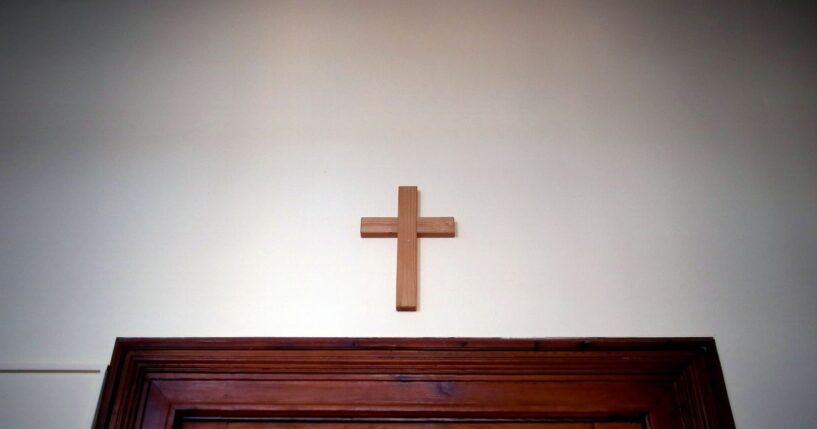
And so, my brother kindly, but firmly, pushed back against his teacher. Today, a small cross stands on the middle school wall as a testament to his conviction and to his Christ.
But this story is not just about my brother. It is not an anecdotal misunderstanding, but a systemic problem. A 2019 survey found K-12 teachers across the country unprepared to deal with issues of religion in schools (Herbstrith, et al., 2019).
When given a short quiz regarding students’ First Amendment rights, our nation’s educators returned a failing grade. On average, they answered more than half of the questions incorrectly. This knowledge gap led many of them to believe that the law was far more restrictive than it actually is.
Such an error leads teachers to operate under a “better safe than sorry” mentality to avoid political or religious backlash. When school teachers only understand half of what the First Amendment actually means, “better safe than sorry” quickly becomes “silence the religious kids.”
This “open” environment sans religion is not truly open, but rather a restricted stage that allows only one worldview to perform. And that worldview is ideological secularism — the religion of the irreligious.
The myth of secularism promises a pluralistic environment where all faith systems are welcome. In reality, however, it delivers a cold environment where faith goes to die.
This is simply unacceptable. My brother had to fight to find his voice; in America, you should be born with it.
HF 2106 seeks to ungag students like my brother. Renamed as Iowa HF 2336, it has passed both houses of the State Legislature and is headed for the governor’s desk. The bill mandates First Amendment training for teachers and increases civil penalties for educators who censor students.
Is this a perfect fix? Goodness, no. But it’s a step in the right direction.
As more and more states adopt similar legislation, religious students will be able to find their voices again as we chase a culture of open expression. But first, we must abandon the myth of secularism.
If public schools are so scared of a 14-year-old’s drawing of a cross that they have to make “joy” illegal, they aren’t teaching tolerance — they are teaching exclusion and calling it neutrality.
Ultimately, this farce of neutrality has failed students, teachers, and our very society. We do not need safe, sterile, silent classrooms; we need brave schools that let students be who they truly are.
The views expressed in this opinion article are those of their author and are not necessarily either shared or endorsed by the owners of this website. If you are interested in contributing an Op-Ed to The Western Journal, you can learn about our submission guidelines and process here.
Advertise with The Western Journal and reach millions of highly engaged readers, while supporting our work. Advertise Today.
Truth and Accuracy
We are committed to truth and accuracy in all of our journalism. Read our editorial standards.