Alert: Trump Says He Will Not Attempt to Overturn Pre-Emptive Fauci Pardon Issued by Biden's Autopen
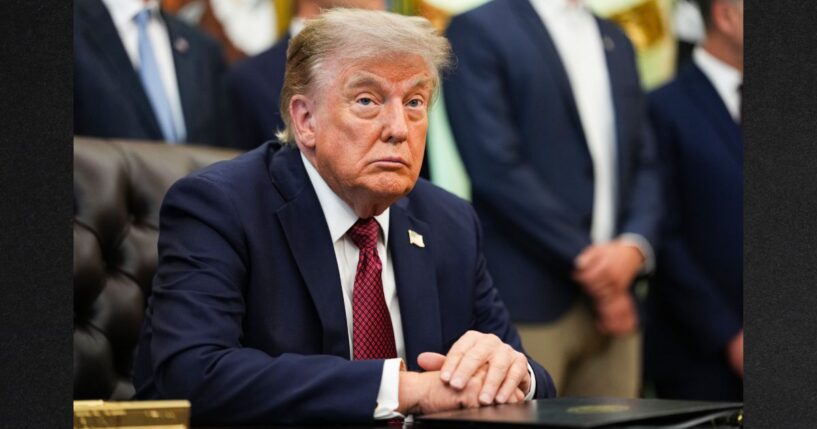
President Donald Trump told reporters Wednesday that he respects the presidential pardon power too much to challenge it.
Trump, often accused of monarchical or even fascist tendencies by his enemies, made those constitutionally reverent comments in the context of then-President Joe Biden’s 2025 pre-emptive pardon of Anthony Fauci, the former director of the National Institute of Allergy and Infectious Diseases and in many ways the architect of the federal government’s response to the COVID-19 pandemic.
“Well, the only thing you can really think about is the autopen,” the president said in a clip posted to the social media platform X, referring to the possibility of overturning Fauci’s pardon based on the reportedly regular use and questionable legality of autopen signatures either by Biden or, more troubling, by others purporting to act in the cognitively diminished former president’s name.
Otherwise, Trump added, the pardon remains valid.
“The most powerful thing a president has, they say, is the power of pardon,” he continued. “So, he was pardoned by Biden. And I respect that. I know how powerful it is; it’s a very powerful — they say it’s literally the most powerful thing a president has.”
From there, Trump again speculated about the legality of an autopen pardon. But he also acknowledged the difficulty in proving that his predecessor did not actually intend to pardon Fauci. Thus, the grant of clemency must stand.
Trump will not challenge the validity of Biden’s pardon for Dr. Fauci pic.twitter.com/YlPOcTHXXl
— Catch Up (@CatchUpFeed) July 29, 2026
The president’s comments came in response to Fauci’s contentious appearance on Capitol Hill early Wednesday.
Republican Sen. Rand Paul of Kentucky, chairman of the Senate Homeland Security and Governmental Affairs Committee, has long called for Fauci’s arrest and prosecution for what the senator has characterized as Fauci’s role in a massive cover-up of substantial evidence that the COVID-19 virus originated in a lab in Wuhan, China, and that Fauci had helped fund the dangerous research taking place inside the lab.
With that in mind, Paul subpoenaed Fauci to testify on Wednesday.
Meanwhile, on Saturday, Paul’s committee released Fauci’s pandemic diary, a near-daily record of the now-former bureaucrat’s activities and reflections as the events of 2020-21 unfolded. In that diary, Fauci recorded private views and developments that did not always square with what he said publicly. He also wrote frequently of his newfound fame and access to celebrities.
According to the Washington Examiner, Secretary of Health and Human Services Robert F. Kennedy Jr. uncovered Fauci’s diary on HHS computer servers and then shared it with Paul.
With his private thoughts laid bare, Fauci appeared before Paul’s committee for an acrimonious hearing. At one point, for instance, the senator called on security to remove one of Fauci’s lawyers for unruly behavior. Paul’s Republican colleagues berated the former bureaucrat.
All the while, Fauci refused to testify. In fact, per the Examiner, he pleaded the Fifth more than 100 times even though he could not incriminate himself due to his pardon.
Still, Trump gave no hint that he would seek to punish Fauci in any way. He merely commented on the former bureaucrat’s strategy.
“I don’t know if he would have been better off not doing it,” the president said, per the Examiner. “There were a lot of questions that I guess he could have answered, and some maybe he didn’t feel comfortable in answering.”
Either way, it appears that Biden’s pardon will stand.
In “Federalist No. 74,” Founding Father and, like Trump, proud New Yorker Alexander Hamilton defended a president’s constitutional power to pardon.
“Humanity and good policy conspire to dictate, that the benign prerogative of pardoning should be as little as possible fettered or embarrassed,” Hamilton wrote. “The criminal code of every country partakes so much of necessary severity, that without an easy access to exceptions in favor of unfortunate guilt, justice would wear a countenance too sanguinary and cruel.”
Moreover, the power of mercy should rest in one person’s hands.
“As the sense of responsibility is always strongest, in proportion as it is undivided,” Hamilton added “it may be inferred that a single man would be most ready to attend to the force of those motives which might plead for a mitigation of the rigor of the law, and least apt to yield to considerations which were calculated to shelter a fit object of its vengeance.”
Hamilton also touted pre-emptive pardons when issued for the proper reasons.
“[I]n seasons of insurrection or rebellion, there are often critical moments, when a welltimed offer of pardon to the insurgents or rebels may restore the tranquillity of the commonwealth; and which, if suffered to pass unimproved, it may never be possible afterwards to recall,” the Founding Father wrote.
Upon taking office in January 2025, Trump pardoned those whom the Biden administration had imprisoned in connection with the Capitol incursion of Jan. 6, 2021. Many of the president’s supporters did not regard that incursion as an insurrection or rebellion, but many of the president’s enemies did.
Advertise with The Western Journal and reach millions of highly engaged readers, while supporting our work. Advertise Today.
Truth and Accuracy
We are committed to truth and accuracy in all of our journalism. Read our editorial standards.