Here's How Brave US Military Operatives Captured Nicolás Maduro

WASHINGTON (AP) — After months of growing military pressure on Venezuelan President Nicolás Maduro, President Donald Trump ordered an operation into the South American country to capture its leader and whisk him to the United States, where his administration planned to put him on trial.
Trump, during a news conference Saturday at his Florida home, laid out the details of the overnight strike, after which he said Maduro and his wife, Cilia Flores, were flown by helicopter to a U.S. warship.
Trump described Maduro as being “highly guarded” in a presidential palace that was “a heavily fortified military fortress in the heart of Caracas.” Maduro had nearly made it to a safe room inside it, Trump told reporters, although “he was unable to close it.”
In an interview earlier Saturday morning on “Fox & Friends Weekend,” Trump said that American forces were armed with “massive blowtorches,” which they would have used to cut through steel walls had Maduro locked himself in the room.
“It had what they call a safety space, where it’s solid steel all around,” Trump told Fox. “He didn’t get that space closed. He was trying to get into it, but he got bum-rushed right so fast that he didn’t get into that. We were prepared.”
Gen. Dan Caine, chairman of the Joint Chiefs of Staff, said at Trump’s news conference that U.S. forces had rehearsed their maneuvers for months, learning everything about Maduro — where he was and what he ate, as well as details of his pets and the clothes he wore.
“We think, we develop, we train, we rehearse, we debrief, we rehearse again, and again,” Caine said, saying his forces were “set” by early December. “Not to get it right, but to ensure we cannot get it wrong.”
Trump said on Fox that U.S. forces had practiced their extraction on a replica building.
“They actually built a house which was identical to the one they went into with all the same, all that steel all over the place,” Trump said.
Trump said the U.S. operation took place in darkness, although he did not detail how that had happened. “The lights of Caracas were largely turned off due to a certain expertise that we have,” Trump said. “It was dark and it was deadly.”
At least seven explosions were heard in Caracas. The attack, which Secretary of War Pete Hegseth described as part of “massive joint military and law enforcement raid,” lasted less than 30 minutes.
Venezuela’s Vice President Delcy Rodríguez, who under law takes power, said some Venezuelan civilians and members of the military were killed.
Yanire Lucas, a Caracas resident whose house sits pressed up next to a Venezuelan military base struck overnight, said she began to hear explosions next to her home around 1:50 a.m.
Trump said a few U.S. members of the operation were injured but he believed no one was killed.
“A couple of guys were hit, but they came back and they’re supposed to be in pretty good shape,” he told Fox.
“We had to do it because it’s a war,” he added.
Caine said one helicopter was struck by fire as it closed in on Maduro’s compound but was able to safely fly on its return.
U.S. forces held off on conducting the operation for days, waiting for cloud cover to pass because the “weather has to be perfect,” Trump said in the television interview.
“We waited four days,” he said. “We were going to do this four days ago, three days ago, two days ago. And then all of a sudden it opened up and we said, go. And I’ll tell you, it’s, it was just amazing.”
Caine said that on Friday night, “the weather broke just enough, clearing a path that only the most skilled aviators in the world could move through.” He said helicopters flew low to the water to enter Venezuela and were covered above by protective U.S. aircraft.
Caine detailed the aircraft and U.S. forces involved in the operation, which he said was named “Absolute Resolve.”
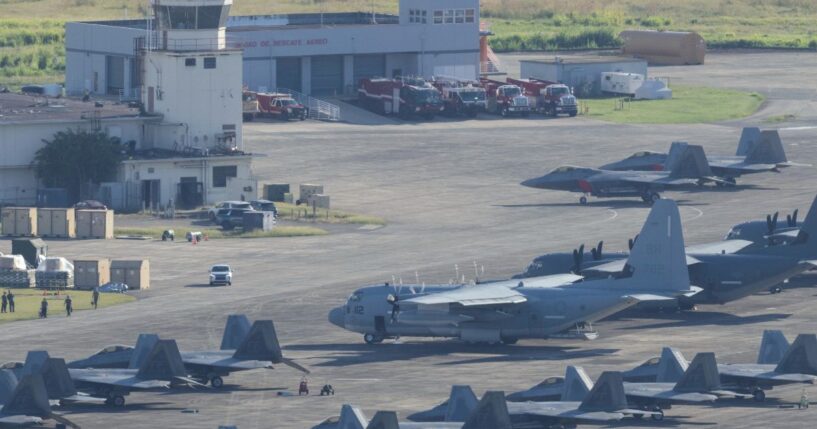
- More than 150 aircraft launched from across the Western Hemisphere, including F-18, F-22, and F-35 fighter jets, B-1 bombers, and drones.
- Trump gave the go-ahead at 10:46 p.m. EST Friday.
- U.S. forces reached Maduro’s compound at 1:01 a.m. EST Saturday and were back over water headed away at 3:29 a.m. EST.
- U.S. service members involved in the operation ranged in age from 20 to 49.
Trump said that Maduro and Flores were flown by helicopter to a U.S. warship and would go on to New York to face charges. He posted on Truth Social a photo of the Venezuelan leader wearing a gray sweatsuit, protective headphones, and a blindfold. The caption said: “Nicolas Maduro on board the USS Iwo Jima.”
The Justice Department released an indictment accusing the pair of having an alleged role in a narco-terrorism conspiracy.
The raid was a dramatic escalation from a series of strikes the U.S. military has carried out on drug-carrying boats in the Caribbean Sea and eastern Pacific Ocean since early September. There had been 35 known strikes that killed at least 115 people.
On Dec. 29, Trump said the U.S. struck a facility where boats accused of carrying drugs “load up.” The CIA was behind the drone strike at a docking area believed to have been used by Venezuelan drug cartels. It was the first known direct operation on Venezuelan soil since the U.S. began its strikes in September.
Trump said at his news conference that group of officials standing behind him, including Hegseth, Caine, and Secretary of State Marco Rubio, will “be a team that’s working with the people of Venezuela.”
The Republican president left open the possibility that U.S. troops would have a presence in the country. “We’re not afraid of boots on the ground if we have to,” he said, adding, “We had boots on the ground last night.”
The U.S. will now “run” the country until a new leader can be chosen, Trump said.
“We’re going to make sure that that country is run properly. We’re not doing this in vain,” he said. “This is a very dangerous attack. This is an attack that could have gone very, very badly.”
___
Kinnard reported from Chapin, South Carolina. Associated Press reporters Regina Garcia Cano and Juan Arraez in Caracas, Venezuela, contributed to this report.
The Western Journal has not reviewed this Associated Press story prior to publication. Therefore, it may contain editorial bias or may in some other way not meet our normal editorial standards. It is provided to our readers as a service from The Western Journal.
Truth and Accuracy
We are committed to truth and accuracy in all of our journalism. Read our editorial standards.
Advertise with The Western Journal and reach millions of highly engaged readers, while supporting our work. Advertise Today.