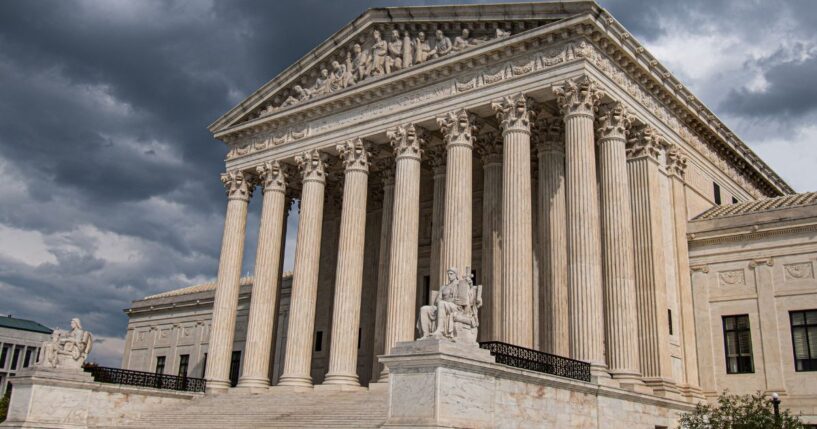


In a 6-3 ruling late last month, Justice Amy Coney Barrett minced no words when it came to so-called “universal injunctions,” lower-court rulings that extended far beyond that court’s jurisdiction.
“It is unnecessary to consider whether Congress has constrained the Judiciary; what matters is how the Judiciary may constrain the Executive,” Barrett wrote in the decision.
“That goes for judges, too,” Barrett added. “When a court concludes that the Executive Branch has acted unlawfully, the answer is not for the court to exceed its power, too.”
That decision, by the way, did not decide the merits of the case in which the universal injunction was issued: President Donald Trump’s administration has argued that the 14th Amendment does not grant birthright citizenship because those born to citizens of other countries within U.S. borders are not among “persons born in the United States and subject to the jurisdiction thereof.”
The meaning of this language, and whether children of foreign nationals are “subject to the jurisdiction” of the United States will eventually be decided one way or another before the high court. But the ruling itself was clear: Before that, nationwide universal injunctions were the judiciary acting in a way that exceeded its power.
So, for the second time since the decision, the judiciary has exceeded its power, because what the heck?
In a 2-1 decision handed down late Wednesday by the 9th U.S. Circuit Court of Appeals, judges ruled that the plaintiffs — attorneys general from four Democratic-led states, Arizona, Illinois, Oregon, and Washington — could receive a nationwide injunction because that was the only way to obtain requisite relief, according to The Hill.
Signing you in…
Please keep this page open. The results will appear here.
Check your email to count your vote
We sent a confirmation link to .
Click Confirm Your Vote in that email to count your vote and unlock the results.
Your vote has not been counted yet. If the email hasn't arrived, check your spam or junk folder.
“States’ residents may give birth in a non-party state, and individuals subject to the Executive Order from non-party states will inevitably move to the States,” U.S. Circuit Judge Ronald Gould wrote in the opinion of the court.
Both Gould and Judge Michael Hawkins, who voted to issue the universal injunctions, were Bill Clinton appointees.
The dissenter was Judge Patrick Bumatay, who was a Trump appointee.
“Courts must be vigilant in enforcing the limits of our jurisdiction and our power to order relief,” Bumatay wrote in his dissent.
“Otherwise, we risk entangling ourselves in contentious issues not properly before us and overstepping our bounds,” he added. “No matter how significant the question or how high the stakes of the case — at all times, we must adhere to the confines of ‘the judicial Power.’”
As The New York Times noted, this is the second time that the same case has received a universal injunction from a lower-court judge despite the fact that I believe they call it the Supreme Court because, in large part, it has supremacy over lower courts.
Judge John C. Coughenour of the Western District of Washington first issued the injunction, ruling that, to use the Times’ words, “Mr. Trump’s executive order would force them to put in place new systems to determine who is eligible for state benefits, and reduce the payments they receive from the federal government.”
Of course, the states could abide by the order until it’s decided before the Supreme Court — which I would assume will happen in relatively short order given the nature of the case — but that isn’t the point.
The point, again, is that the Supreme Court is only so supreme when it acts as rubber-stamp branch of the left. It no longer does so. Now, the left relies on lower courts to do that. The Supreme Court ended that, too.
Their response? Well, apparently, their argument is something along the lines of the fictional non-jurist Jeff “The Dude” Lebowski: “Well, you know, that’s just like uh, your opinion, man.”
It’s almost as if they’re setting out to prove the Trump administration’s point.
To be fair to the fictional Mr. Lebowski, his reasoning was only slightly better than Justice Ketanji Brown Jackson’s dissent. Both, however, should hold as much force as the law of the land.