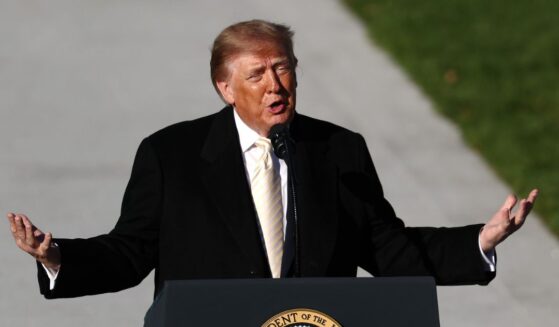
President Donald Trump said Friday he has directed Secretary of State Mike Pompeo to delay a planned trip to North Korea, citing insufficient progress on denuclearization.
Trump put some blame on Beijing, saying he does not believe China is helping “because of our much tougher Trading stance.”
The surprise announcement appeared to mark a concession by the president to domestic and international concerns that his prior claims of world-altering progress on the peninsula had been strikingly premature.
“I have asked Secretary of State Mike Pompeo not to go to North Korea, at this time, because I feel we are not making sufficient progress with respect to the denuclearization of the Korean Peninsula,” Trump tweeted Friday, barely two months after his June meeting with the North’s Kim Jong Un in Singapore.
Trump’s comment followed a report issued Monday by the International Atomic Energy Agency outlining “grave concern” about the North’s nuclear program. It came a day after Pompeo appointed Stephen Biegun, a senior executive with the Ford Motor Co., to be his special envoy for North Korea and said he and Biegun would visit next week.
The State Department never confirmed details of the trip, but it had been expected that Pompeo would be in Pyongyang for at least several hours Monday, according to several diplomatic sources familiar with the plan.
White House officials did not immediately comment on what prompted Trump to call off Pompeo’s trip. The State Department had no immediate comment on the matter and referred questions to the White House.
Signing you in…
Please keep this page open. The results will appear here.
Check your email to count your vote
We sent a confirmation link to .
Click Confirm Your Vote in that email to count your vote and unlock the results.
Your vote has not been counted yet. If the email hasn't arrived, check your spam or junk folder.
Trump laid unspecified blame on China, North Korea’s leading trade partner, which is widely believed to hold the greatest sway over Kim’s government.
The U.S. and China have been locked in a trade dispute for months, with each side ratcheting up tariffs on imports from the other country in what may be the opening salvos of a trade war.
Trump tweeted that “Pompeo looks forward to going to North Korea in the near future, most likely after our Trading relationship with China is resolved.” He added: “In the meantime I would like to send my warmest regards and respect to Chairman Kim. I look forward to seeing him soon!”
After more a year of escalating tensions defined by nuclear and missile tests, new sanctions and “fire and fury” rhetoric, Trump made history meeting Kim earlier this year. In the run-up to the summit both nations engaged in hard-nosed negotiation, with Trump publically calling off the meeting in an effort to push Kim to agree to nuclear concessions. During the summit, the pair signed a vague joint statement in which the North agreed to denuclearize, but which left nearly all details undefined.
“There is no longer a Nuclear Threat from North Korea,” Trump declared on Twitter after the meeting.
“Before taking office people were assuming that we were going to War with North Korea. President Obama said that North Korea was our biggest and most dangerous problem,” he added. “No longer – sleep well tonight!”
Pompeo would have been hard pressed to return from Pyongyang with anything resembling progress on the denuclearization front.
Although it has halted nuclear and missile testing and taken some unrelated steps — dismantling portions of a missile engine facility and returning the suspected remains of American servicemen killed during the Korean War — its nuclear weapons program and ballistic missile development remain intact, according the U.N.’s atomic watchdog and intelligence agencies.
In addition, recent statements from North Korean officials have ruled out any new concessions until it sees a reciprocal gesture from the U.S. beyond suspending military exercises with South Korea. North Korea has been demanding that the U.S. ease or lift crippling sanctions — something Pompeo and national security adviser John Bolton have flatly ruled out until the its nuclear program is fully and verifiably dismantled.
Other than sanctions relief, the North, backed by South Korea, has been seeking a declaration of the end of the Korean War. The conflict stopped with the signing of an armistice rather than a peace treaty, meaning the war is not technically over. Both the North and South have vowed to end the open state of hostilities, and Seoul had been hoping to persuade the Trump administration to sign off on a non-binding end-of-war declaration as a goodwill gesture that would give Kim Jong Un domestic cover to proceed with denuclearization moves.
Pompeo and other administration officials have suggested some concessions short of easing or lifting sanctions are possible before verified denuclearization, but have refused to be specific about what they could be. And they have been skeptical about an end-of-war declaration in the absence of any progress on the nuclear matter.
At the same time, lawmakers from both parties, including GOP hawks who generally support Trump, have expressed concerns about such a move, as it could be used by the North to demand the removal of U.S. troops from South Korea and potentially Japan without anything in return.
Trump had kept up the positive tone as recently as Tuesday at a campaign rally in West Virginia. There Trump maintained “we’re doing well with North Korea.”
“There’s been no missile launches. There’s been no rocket launches,” he added.
At the same rally, Trump seemed to take a different tone too on China, saying he had withheld some criticism of China because “I wanted them to help us with North Korea and they have.”
The Western Journal has reviewed this Associated Press story and may have altered it prior to publication to ensure that it meets our editorial standards.