Op-Ed: Before Trump, There Was Buchanan

The lights of the Houston Astrodome burned brightly on the evening of Aug. 17, 1992, as thousands of Republican delegates gathered for the party’s national convention. They had come to renominate President George H. W. Bush and begin the general election campaign.
Before the night was over, the convention would be remembered for a speech delivered by the man who had just failed to defeat Bush for the Republican nomination.
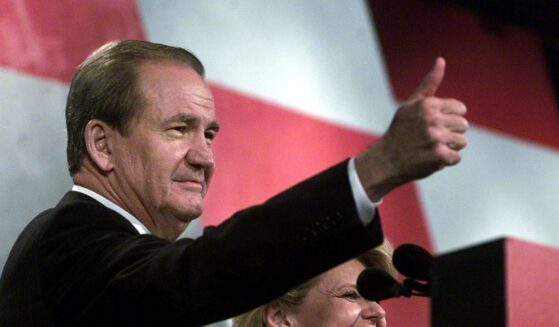
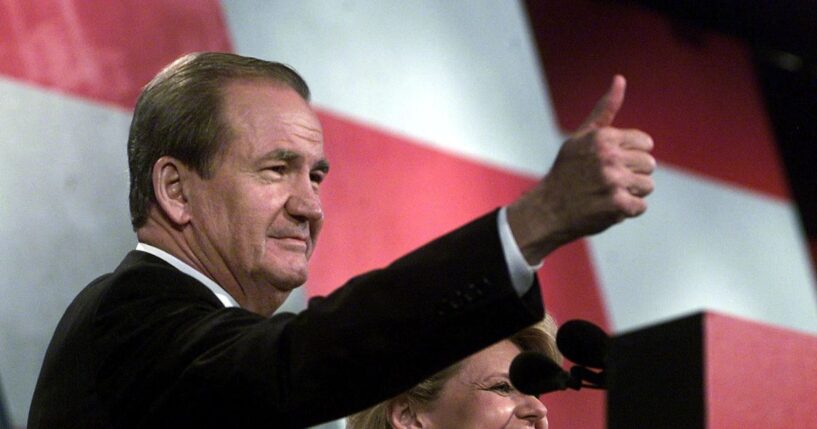
The former White House aide Pat Buchanan approached the podium and delivered the speech that became the defining moment of his political career.
“There is a religious war going on in this country. It is a cultural war, as critical to the kind of nation we shall be as the Cold War itself, for this war is for the soul of America.”
The speech drew immediate backlash. Liberal columnist Molly Ivins wrote that Buchanan’s speech “probably sounded better in the original German.” Many Republicans feared it had overshadowed President Bush’s convention.
Buchanan had lost his challenge to George H. W. Bush. His campaign attracted loyal supporters and forced the president to defend his record, but it ended without the Republican nomination. In Washington, many saw his campaign as the last stand of a movement they believed had already lost.
After the Cold War, Washington embraced free trade, intervention abroad, and a more integrated global economy. Buchanan believed all three were mistakes.
Months before the convention in Houston, Buchanan challenged President George H. W. Bush in the Republican primaries. He traveled across New Hampshire in a van bearing “Buchanan Brigade” signs, speaking to voters who believed the Republican establishment had stopped listening to them.
Buchanan’s showing surprised Washington. In the New Hampshire primary, he won 37 percent of the vote against an incumbent president. Bush remained the favorite and eventually secured the nomination, but the result revealed a sizable group of Republican voters who believed the party was headed in the wrong direction.
Buchanan challenged George H. W. Bush on issues that put him outside the Republican mainstream. His most persistent warning concerned the future of American manufacturing.
Many in Washington welcomed a more integrated global economy. Buchanan warned that American factories and the communities built around them would suffer. His opposition to the North American Free Trade Agreement separated him from much of the Republican establishment and many Democrats. Buchanan argued that American manufacturers would shift production to Mexico, where labor costs were far lower.
Factory closures spread across much of the industrial Midwest throughout the 1990s and early 2000s, while manufacturing employment kept falling. Communities that had depended on mills and assembly plants spent years trying to replace the jobs they had lost. Washington remained committed to free trade even as more towns experienced the problems Buchanan had warned about.
Immigration was a central issue in Buchanan’s campaign. During a visit to the U.S.-Mexico border in 1992, Buchanan called the federal government’s failure to secure the border “a national disgrace” and described illegal immigration as “an illegal invasion.”
Buchanan’s foreign policy also broke with the Republican establishment. He summarized it in one line: “America First, and second, and third.”
Republicans gathered in Houston that August after Buchanan had lost the nomination. President Bush entered the general election with the Gulf War still regarded as one of his administration’s greatest successes.
Bush lost the White House to Bill Clinton in November 1992. Eight years later, George W. Bush entered the Oval Office. The attacks of September 11 changed the country’s priorities, replacing the optimism of the post-Cold War years with the War on Terror.
After September 11, Republicans largely embraced the wars in Afghanistan and Iraq. Buchanan remained one of the movement’s most persistent critics.
The financial crisis of 2008 hit many manufacturing communities hard. Years of factory closures had already weakened local economies, and the recession pushed unemployment even higher. Many Americans lost faith in the political establishment as frustration mounted.
Buchanan remained active in national politics after 1992. He sought the Republican nomination again in 1996 and later ran as the Reform Party’s presidential candidate in 2000. He never won the presidency, but more Republicans began to embrace the issues he had raised for years.
The date was June 16, 2015. Donald Trump descended the golden escalator inside Trump Tower and announced his campaign for president. Political reporters and Republican strategists dismissed his campaign. Former Florida governor Jeb Bush, the son of President George H.W. Bush and the brother of President George W. Bush, dismissed Trump as “not a serious candidate.”
The Republican primary quickly exposed a divide within the party. Bush defended the Republican policies that had defined the party since the end of the Cold War. Trump repeated many of the arguments Buchanan had made against Bush’s father more than two decades earlier.
Trump devoted much of his campaign to trade. He called the North American Free Trade Agreement “the worst trade deal maybe ever signed, anywhere,” arguing that it had encouraged American companies to move factories overseas. He echoed many of the same arguments Buchanan had made during his 1992 challenge to George H. W. Bush.
Immigration became another major theme of Trump’s campaign. “When Mexico sends its people, they’re not sending their best,” he said during his announcement speech. Buchanan had made border security a central issue during his 1992 campaign. In 2015, many more Republican voters embraced that message than they had two decades earlier.
For years, most Republican voters and elected officials had backed the Bush family’s foreign policy. Trump attacked that record in a Republican presidential debate. Twenty-four years after Buchanan’s campaign, many more Republicans agreed with his views on foreign policy.
Three days after the South Carolina primary, Jeb Bush suspended his campaign. Trump had won the state with 32.5 percent of the vote, while Bush finished fourth with 7.8 percent. Trump kept winning primaries. Indiana proved decisive. Ted Cruz suspended his campaign on May 3, 2016, and John Kasich withdrew the following day. Trump became the Republican nominee.
Buchanan never became president or won the Republican nomination. Yet on July 21, 2016, Donald Trump accepted the Republican nomination after running on many of the same themes Buchanan had championed for decades. Some 24 years after Houston, Buchanan’s ideas had become the Republican Party’s platform.
The views expressed in this opinion article are those of their author and are not necessarily either shared or endorsed by the owners of this website. If you are interested in contributing an Op-Ed to The Western Journal, you can learn about our submission guidelines and process here.
Advertise with The Western Journal and reach millions of highly engaged readers, while supporting our work. Advertise Today.
Truth and Accuracy
We are committed to truth and accuracy in all of our journalism. Read our editorial standards.