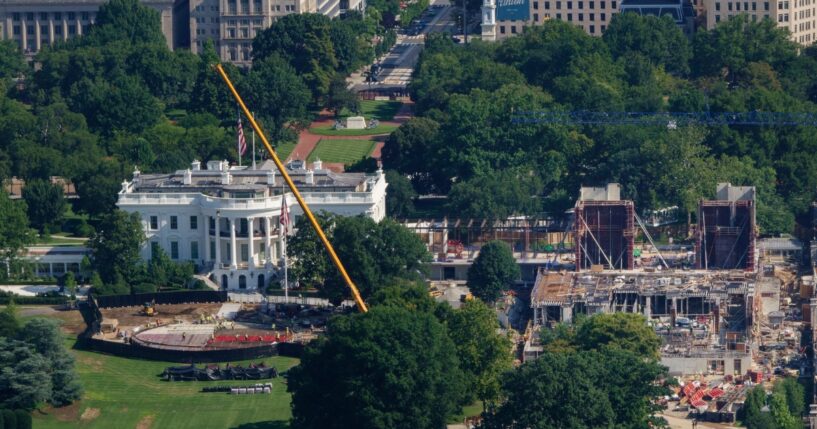
Federal Appeals Court Orders Trump to Halt Ballroom Construction, Rules Project Is 'For Congress to Decide'

A three-judge D.C. Court of Appeals panel on Friday upheld a lower court ruling blocking President Donald Trump from going forward with constructing a ballroom at the White House.
Last fall, Trump directed the construction of a 90,000-square-foot ballroom on the east side of the White House with $400 million in private donations. Underneath it, a new bunker is also being constructed by the Department of War with enhanced security measures.
In a 2-1 ruling, Judges Patricia Millett, an Obama appointee, and Bradley Garcia, a Biden appointee, wrote in their majority opinion, “Whether or not a massive ballroom should be constructed is for Congress to decide and is not a matter for Executive self-help.”
“This holding has nothing at all to do with whether the proposed ballroom is desirable, or not, as a matter of policy. This ruling does not even necessarily mean that the Defendants may not ultimately construct the ballroom,” the judges continued.
“What it does mean is that the Defendants may not do so during the district court’s expeditious litigation without securing Congress’s authorization, as the Constitution and laws require,” Millett and Garcia said.
The judges pointed to the Constitution’s Property Clause, which they said “vests Congress with plenary control over all real property that belongs to the United States.”
“In 1912, Congress placed a statutory exclamation point on its exclusive powers by providing that “there shall not be erected on any reservation, park, or public grounds[] of the United States within the District of Columbia, any building or structure without express authority of Congress,” the judges wrote.
However, Judge Neomi Rao, a Trump appointee, held a different view in her dissent to Friday’s ruling.
She first contended that the National Trust for Historic Preservation, which filed the suit, had no standing to bring it, and that the federal district court had no authority to issue an injunction in March stopping its construction.
“This was a blatant abuse of discretion. To begin with, the district court had no jurisdiction because the Trust has no standing to stop construction at the White House. The ballroom is also likely within the President’s authority to make improvements to the Executive Residence at the White House,” Rao wrote.
Past presidents have done so.
“The balance of equities overwhelmingly favors the government. The district court elevated the aesthetic displeasure of a single passerby over the government’s security interests in the ballroom and the security risks of leaving an open construction site at the President’s home and office,” Rao said.
“The district court seized supervision of construction at the White House, and my colleagues affirm this judicial overreach… Because the injunction is beyond the proper province of the federal courts, construction should be allowed to continue,” the judge concluded.
The Associated Press reported that the D.C. Circuit Court put a two-week stay on its order to halt construction in order to give the Trump administration time to appeal the ruling to the Supreme Court, which the president said he plans to do.
“We will be immediately appealing to the United States Supreme Court. The Military and Secret Service are viewing this horrendous, politically motivated, and unlawful ruling as a National Security threat to our Nation in that the entire Complex is being built for the protection of our Country and, additionally, all future Presidents,” Trump posted on Truth Social.
— Rapid Response 47 (@RapidResponse47) August 7, 2026
“The single, integrated project includes Bomb Shelters, State of the Art Hospital and Medical Facilities, Protective Partitioning, Top Secret Military Facilities, Structures and Equipment, Protective Missile Resistant Steel, Columns, Roofs, and Beams, Drone Proof Ceilings and Roofs, Military Grade Venting, and Bullet, Ballistic, and Blast Proof Glass,” he added.
Trump ended, “This unjust decision must be overturned by the Supreme Court in its entirety.”
Both the U.S. Commission of Fine Arts and the 12-member National Capital Planning Commission have approved the ballroom plans.
Advertise with The Western Journal and reach millions of highly engaged readers, while supporting our work. Advertise Today.
Truth and Accuracy
We are committed to truth and accuracy in all of our journalism. Read our editorial standards.