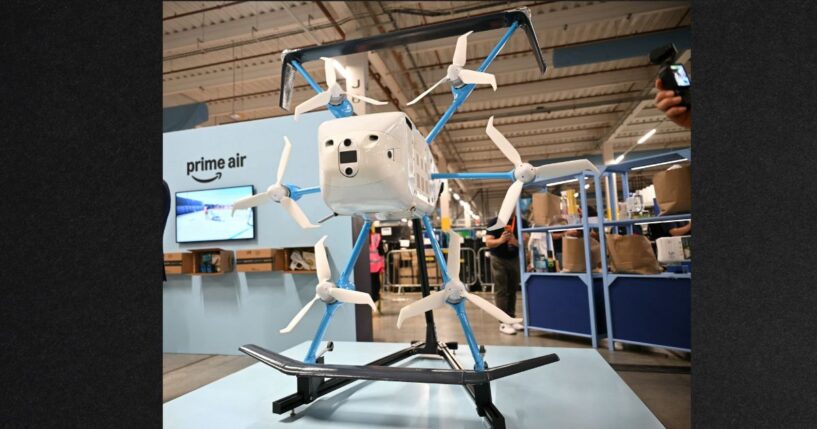


On Friday afternoon in Huntington Woods, Michigan, an Amazon delivery drone finished dropping off a bottle of shampoo, then hit a fiber-optic cable, lost control, snagged a power line, and dropped onto a neighbor’s garage.
The customer who received the shampoo watched the drone climb into the wire after the drop and saw it thrash around before settling on the next roof.
Shingles on the garage were torn up, and utility crews had to cut power so the 80-pound machine could be pulled off the roof. No one was injured.
The National Transportation Safety Board is still deciding whether the crash deserves a full investigation or not, according to the Detroit Free Press.
These drones are not toys. The MK30 model carries packages up to five pounds and flies autonomously beyond visual line of sight under an FAA exemption, WXYZ-TV reported.
Amazon says it has completed hundreds of thousands of drone deliveries this year. “Safety is our top priority and incidents are extremely rare,” Amazon spokesman Jack Stelzner told the Detroit Free Press.
Signing you in…
Please keep this page open. The results will appear here.
Check your email to count your vote
We sent a confirmation link to .
Click Confirm Your Vote in that email to count your vote and unlock the results.
Your vote has not been counted yet. If the email hasn't arrived, check your spam or junk folder.
“Anytime a delivery does not go as planned, we investigate what happened.”
The homeowner whose garage was hit said he was glad the outcome wasn’t worse. He said Amazon crews arrived quickly and prioritized removing the hot battery.
He told the Detroit Free Press he supports the concept of drone delivery; however, “I think they should look into reconstructing the zones and who is eligible for these drone drop offs because, say they had cut an electrical wire and sparked a flame, then our whole house is in flames.”
He said he believes the company should rethink which neighborhoods are appropriate, especially older suburbs packed with overhead wires, tight backyards, and detached garages.
Would you want an 80-pound autonomous aircraft with spinning propellers and a heavy, hot battery routinely flying over your street, your yard, your kids’ play area, or your power lines? This crash would make anyone nervous.
“Extremely rare” is not reassuring when the failure mode involves a substantial machine falling onto a roof or hanging from a live wire.
Amazon has recorded other crashes since testing began in 2021, and regulators have examined prior incidents. Yet the service keeps expanding, because 30-minute deliveries are convenient and the emissions claims sound appealing on paper.
Convenience does not cancel out the physical reality of heavy, fast-moving objects operating in cluttered residential airspace.
Until these systems can reliably avoid the ordinary obstacles of American neighborhoods — utility lines, trees, service drops, and small structures — residents are justified in questioning whether their streets should serve as test ranges.
If the NTSB opens an investigation, it should look beyond this single flight.
The real question is whether current safety margins are adequate for routine autonomous operations over populated areas.