Trump Economic Adviser Reveals How Much the Administration Cut the Deficit in Year One

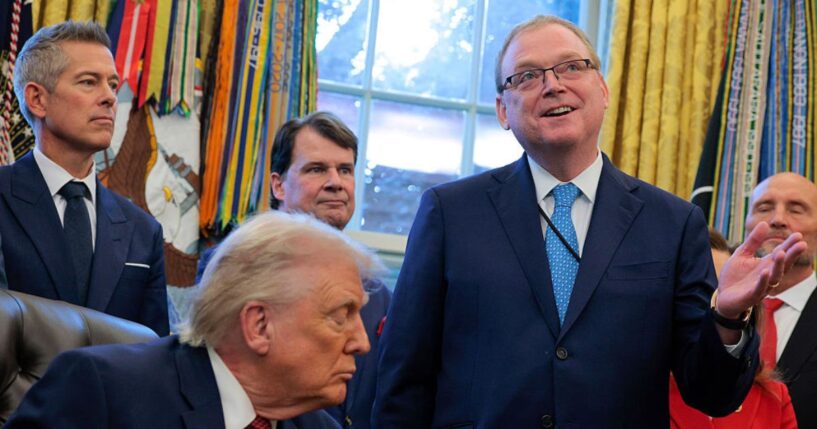
President Donald Trump’s Director of the National Economic Council, Kevin Hassett, set the record straight Wednesday regarding the positive impact the administration is having on the national debt.
Hassett told CNN, “We were in a fiscal situation that was completely out of control when [Trump] came into office, and now we’ve reduced the deficit by about $600 billion this year, because of high growth, tariff revenue, and reducing the federal workforce.”
“We’ve reduced federal workers by 360,000 people, and that’s, like, almost $30 billion a year in savings. What President Trump is doing is taking a big step towards getting closer to a balanced budget,” he noted.
“That kind of fiscal responsibility is something that people have been asking governments of both parties to do for a long time,” Hassett said.
KEVIN HASSETT: “We’ve reduced federal workers by 360,000 people, and that’s like almost $30 billion a year in savings … We were in a fiscal situation that was completely out of control when @POTUS came into office, and now we’ve reduced the deficit by about $600 billion …” pic.twitter.com/OQ7pPYPIPo
— Trump War Room (@TrumpWarRoom) February 11, 2026
White House Deputy Chief of Staff James Blair also called out Politico for reporting that Trump policies are running up the deficit in a story headlined “US Debt Forecast to Hit $64T in a Decade as Trump Policies Widen Deficit.”
“The January 2026 deficit is literally 35% lower than the January 2025 deficit. This … headline is fake. Made Up,” he posted on social media.
The January 2026 deficit is literally 35% lower than the January 2025 deficit.
This is headline is fake. Made Up.
Fugazi math to push a narrative. https://t.co/DX3S4Zl1uK
— James Blair (@JamesBlairUSA) February 11, 2026
During Trump’s first term, in fiscal year 2019, before the pandemic, the federal government spent $4.4 trillion, with a $984 billion deficit.
During President Joe Biden’s last year in office, well after the pandemic, the federal government spent $6.8 trillion, with a deficit of $1.8 trillion. So the Biden administration, working hand-in-hand with a Democratic-led Congress, tacked on $2.4 trillion in annual expenditures.
In fact, the 2024 level of spending was $200 billion more than in 2020, when, on a bipartisan basis, the federal government appropriated trillions in pandemic-related spending.
So Biden and the Democrats never returned annual federal expenditures anywhere close to pre-pandemic levels.
Under the previous administration, the size of the federal workforce increased by 6 percent, with the total topping 3 million in the fall of 2024 for the first time since 1990, according to USA Facts.
In contrast, White House Press Secretary Karoline Leavitt posted on X, “In President [Donald] Trump’s second term, 615,000 private sector jobs have been added while federal employment has declined to its lowest level since 1966 — and the lowest level in recorded history as a share of the total workforce.”
In President Trump’s second term, 615,000 private sector jobs have been added while federal employment has declined to its lowest level since 1966 — and the lowest level in recorded history as a share of the total workforce. pic.twitter.com/GD2HMCtcui
— Karoline Leavitt (@PressSec) February 11, 2026
The Bureau of Labor Statistics reported, “In January, federal government employment continued to decline (-34,000) as some federal employees who accepted a deferred resignation offer in 2025 came off federal payrolls. Since reaching a peak in October 2024, federal government employment is down by 327,000, or 10.9 percent.”
The total federal workforce is now just under 2.7 million.
In December, Treasury Secretary Scott Bessent posted on social media, “Thanks to President [Donald] Trump, the health of the U.S. government’s finances is improving.”
“The current calendar year-to-date deficit is $1.52 trillion, which compares to a deficit of $1.93 trillion for the comparable period last year under Biden, a 21% drop,” the treasury secretary wrote.
“Not only is the deficit smaller under President Trump – the economy is also bigger. The full 2025 calendar year budget deficit to GDP may total only 5.5%, substantially lower than the unsustainably high 6.8% in calendar year 2024 under Biden,” he added.
Thanks to President Trump, the health of the U.S. government’s finances is improving.
The current calendar year-to-date deficit is $1.52 trillion, which compares to a deficit of $1.93 trillion for the comparable period last year under Biden, a 21% drop.
Not only is the deficit…
— Treasury Secretary Scott Bessent (@SecScottBessent) December 15, 2025
Total revenue to the federal treasury for fiscal year 2025, which ended on Sept. 30, was $5.23 trillion versus fiscal year 2024’s $4.9 trillion. That marks an increase of over $300 billion, which can be attributed partly to increased tariff revenue and a growing economy.
The federal government reportedly collected $264 billion in revenues in 2025, versus $118 billion in 2024.
It’s worth noting that most of Trump’s tariffs did not kick in until April of last year, meaning tariff revenues will likely be significantly higher in 2026.
So through economic growth, tariff revenues, and cutting spending, Trump is getting the nation’s fiscal house back in order.
Truth and Accuracy
We are committed to truth and accuracy in all of our journalism. Read our editorial standards.
Advertise with The Western Journal and reach millions of highly engaged readers, while supporting our work. Advertise Today.