BREAKING: Justice Clarence Thomas Issues Blistering Dissent in Tariff Case Following Trump Loss

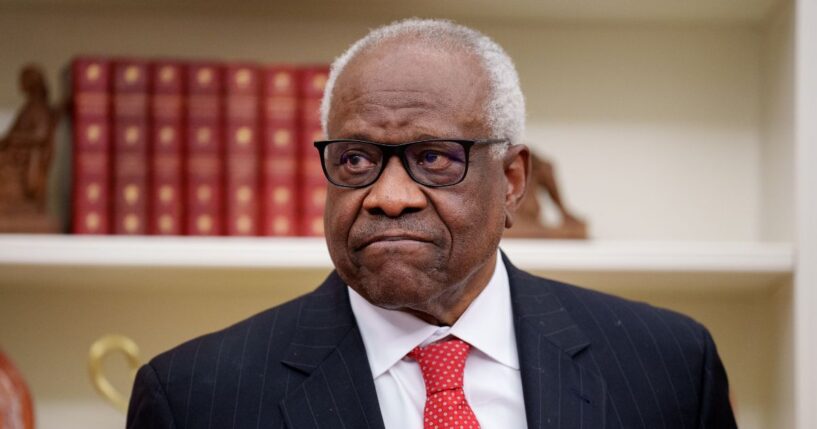
Supreme Court Justice Clarence Thomas joined two of his colleagues in dissenting from an unfortunate opinion.
On Friday, according to The Carolina Journal, SCOTUS ruled 6-3 that, under the 1977 International Emergency Economic Powers Act, President Donald Trump does not have the authority to impose tariffs, a power the U.S. Constitution assigns to the legislature.
In a separate dissent, Thomas insisted that the high court’s majority got it wrong.
The legendary conservative justice argued that while Congress may not delegate its “core legislative power,” it may delegate (and many times has delegated) enumerated powers such as the tariff-making power.
“Because the Constitution assigns Congress many powers that do not implicate the nondelegation doctrine, Congress may delegate the exercise of many powers to the President. Congress has done so repeatedly since the founding, with this Court’s blessing,” Thomas wrote. “The power to impose duties on imports can be delegated.”
In 2025, Trump invoked IEEPA as a statutory justification for his sweeping tariffs.
Crucially, IEEPA’s Sec. 203 authorized the president to “investigate, regulate, direct and compel, nullify, void, prevent or prohibit, any acquisition, holding, withholding, use, transfer, withdrawal, transportation, importation or exportation of, or dealing in, or exercising any right, power, or privilege with respect to, or transactions involving, any property in which any foreign country or a national thereof has any interest; by any person, or with respect to any property, subject to the jurisdiction of the United States.”
Assuming one could even imagine a broader delegation of emergency powers, one wonders if human language could express it.
Indeed, both Thomas and Justice Brett Kavanaugh placed proper emphasis on the words “regulate” and “importation.”
“I join Justice Kavanaugh’s principal dissent in full,” Thomas began. “As he explains, the Court’s decision today cannot be justified as a matter of statutory interpretation. Congress authorized the president to “regulate…importation.”
Moreover — and here lies the key — “[t]hroughout American history, the authority to ‘regulate importation’ has been understood to include the authority to impose duties on imports.”
🚨 BREAKING: SCOTUS Justice Clarence Thomas dropped straight TRUTH BOMBS in his dissent on the tariffs
He nailed it.
“NEITHER the statutory text nor the Constitution provide a basis for ruling against the President.” 🔥
“Congress authorized the President to “regulate . . .… pic.twitter.com/nhKtBQ669Y
— Eric Daugherty (@EricLDaugh) February 20, 2026
As one might expect, conservative Justice Samuel Alito joined Thomas and Kavanaugh in dissenting.
Meanwhile, Chief Justice John Roberts, along with Justices Neil Gorsuch and Amy Coney Barrett, joined the three liberals — Justices Elena Kagan, Sonia Sotomayor, and Ketanji Brown Jackson — in the majority.
Gorsuch in particular merits some attention, for he invoked the “major questions doctrine.”
“The Constitution lodges the Nation’s lawmaking powers in Congress alone, and the major questions doctrine safeguards that assignment against executive encroachment,” Gorsuch wrote. “Under the doctrine’s terms, the President must identify clear statutory authority for the extraordinary delegated power he claims. And, as the principal opinion explains, that is a standard he cannot meet.”
In short, Gorsuch regularly seems inclined to err on any side of any question that protects strict constitutional interpretation. He does not want the government stretching its powers through liberal readings of that Founding document. In that sense, he resembles Republican Rep. Thomas Massie of Kentucky.
Notably, the three liberals joined the majority in ruling against the tariffs but avoided reliance on the major-questions doctrine. That is because Kagan, Sotomayor, and Jackson approve of a liberal reading of the Constitution in general, but not in a way that might expand Trump’s power, which makes them hypocrites.
As Thomas and Kavanaugh showed, however, the major-questions doctrine has no relevance. After all, Congress expressly authorized the president to “regulate…importation.”
Trump reportedly denounced the ruling as a “disgrace.”
Thomas, it seems, would agree. Based on the principle of “when in doubt, read the statute,” we do too, for IEEPA’s express grant of emergency regulatory power could not be more clear.
Advertise with The Western Journal and reach millions of highly engaged readers, while supporting our work. Advertise Today.
Truth and Accuracy
We are committed to truth and accuracy in all of our journalism. Read our editorial standards.