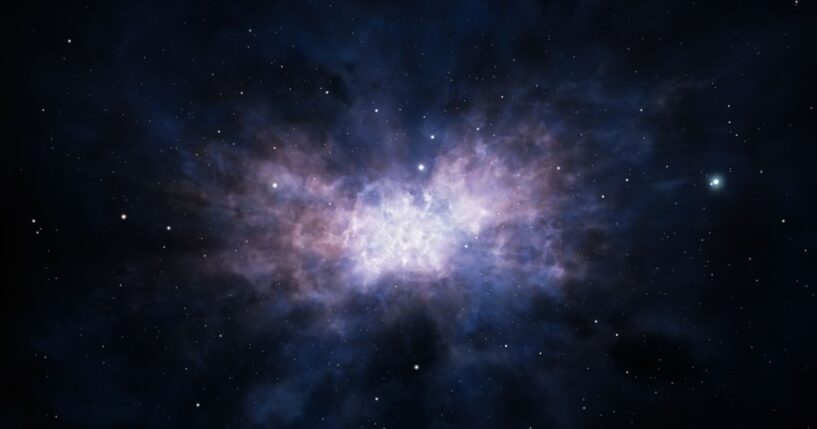



Skywatchers are scanning the night sky for an explosion that happened 3,000 years ago.
A nova called T Coronae Borealis, called the “Blaze Star,” is expected to soon be visible in the night sky, according to Space.com. Experts say it will be visible without fancy equipment.
That pairing of a hot, red giant star and a cool, white dwarf star is about 3,000 light years away. Because it explodes every 78 to 80 years, and the last explosion took place in 1946, the next explosion has been expected for months.
In April, the constellation that hosts the Blaze Star will rise in the eastern sky three hours after the sun sets and be visible about four hours after sunset.
Predictions that the explosion will be visible have been ongoing for months, with some stretching as far into the future as Nov. 10, June 25, 2026, and Feb. 8, 2027, according to ABC.
Blaze Star that’s 3,000 lightyears away will soon explode — and you’ll get to see it from Earth: ‘Once-in-a-lifetime event’ https://t.co/R5041ZHwM8 pic.twitter.com/jyb45TywAD
— New York Post (@nypost) April 5, 2025
Signing you in…
Please keep this page open. The results will appear here.
Check your email to count your vote
We sent a confirmation link to .
Click Confirm Your Vote in that email to count your vote and unlock the results.
Your vote has not been counted yet. If the email hasn't arrived, check your spam or junk folder.
“It could go up tonight, it could go up next month, any month now, there you go,” Louisiana State University professor Brad Schaefer said, according to WBRZ-TV.
He said the explosion comes about as material from one star lands on the other.
“They’re so close that matter from the big normal star falls onto the white dwarf, accumulates on the surface, and at some point, you’ll accumulate enough matter that you have a thermonuclear runaway reaction. It’s a hydrogen bomb,” Schaefer said.
The smaller star will not be consumed because “it’s an incredibly dense, well, white dwarf.”
“So even having a hydrogen bomb on the surface of it, just eats off a little bit of the outer layer. White dwarfs are incredibly sturdy,” Schaefer said.
Elizabeth Hays, chief of the Astroparticle Physics Laboratory at NASA Goddard, said amateurs wanting a peek will probably get their first clue on social media, according to NASA.
“Citizen scientists and space enthusiasts are always looking for those strong, bright signals that identify nova events and other phenomena,” Hays said. “Using social media and email, they’ll send out instant alerts, and the flag goes up. We’re counting on that global community interaction again with T CrB.”
Rebekah Hounsell, an assistant research scientist specializing in nova events at NASA’s Goddard Space Flight Center in Greenbelt, Maryland, said seeing the explosion will be “a once-in-a-lifetime event that will create a lot of new astronomers out there, giving young people a cosmic event they can observe for themselves, ask their own questions, and collect their own data.”
“It’ll fuel the next generation of scientists,” she said.
Blaze Star Explosion: Earth View
We created this animation to show how the Blaze Star, T Coronae Borealis (T CrB), will appear from Earth when it explodes this week. This rare event, happening once every 80 years, will light up the night sky, visible without a telescope. pic.twitter.com/VGICtcfSbO— TheBrainMaze TBM (@thebrainmaze) March 26, 2025
“There are a few recurrent novae with very short cycles, but typically, we don’t often see a repeated outburst in a human lifetime, and rarely one so relatively close to our own system,” Hounsell said. “It’s incredibly exciting to have this front-row seat.”
The Blaze Star was first noticed in 1217 by a monk named Burchard in Ursberg, Germany.