We Can Pay Workers Well While Outcompeting Cheap Chinese Labor: AI Made it All Possible

To rebuild its industrial base, the United States needs more than “reshoring.” It needs highly productive factories where automation makes American workers more competitive.
When one thinks of the glory days of American manufacturing, the mind wanders to the 1950s.
In 1953 alone, manufacturing represented 32 percent of all nonfarm-related employment, peaking in June 1979, when it accounted for 19.6 million jobs.
In the decade between 1950 and 1960, manufacturing constituted roughly 28 percent of the nation’s GDP.
This “perfect storm of dominance,” as some historians often refer to it, was a byproduct of a “historical fluke.” The unique set of circumstances driving the American manufacturing engine included a depleted post-World War II Europe and Japan, which possessed near-zero manufacturing capabilities, while China was embroiled in a civil war.
This left the U.S. as one of the only major industrial economies functioning at full capacity.
On the European end, the Marshall Plan used American dollars to fund the postwar reconstruction of the continent, purchasing most of the necessary industrial equipment and supplies from American producers.
Today America’s manufacturing numbers have dropped, with manufacturing representing just under 10 percent of nonfarm employment or 13 million jobs, accounting for a mere 13.7 percent of GDP. Manufacturing has migrated in most part to China; between 1995 and 2023, while America’s share of global manufacturing value add slid from 23.6 percent to 15 percent, China’s share grew nearly 600 percent, from 4.9 percent to 31.8 percent.
Considering the current state of affairs, the question beckoning is, “What would it actually take for manufacturing in America to become competitive again?”
The answer lies not in limiting foreign imports nor in manufacturing subsidies. Simply put, America needs a fundamentally more productive manufacturing model, one that combines AI and automation with the American work ethic and manufacturing prowess, creating a new modality for domestic production.
If, however, America wants to bring back the “assembly line,” it will need to first solve the competitiveness problem.
Yet the thinking here needs to be even more nuanced, focusing on how to bring manufacturing back without recreating the economic conditions that pushed it overseas in the first place.
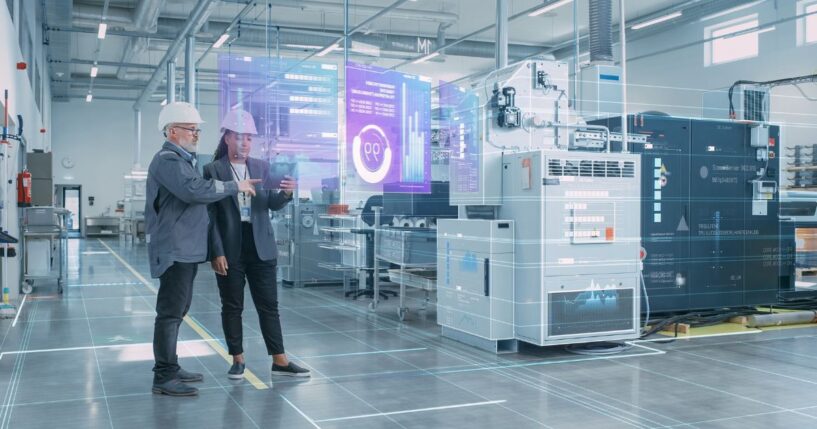
This new manufacturing model will be”the factory of the future.” Instead of adopting the naysayers’ mantra, according to which “automation is making workers redundant,” America must embrace a paradigm shift, seeing automation as something that will increase worker productivity.
America’s competitive edge over China is in its highly educated workforce, alongside its position as a global leader in technological innovation, as well as high levels of investment capital.
That, coupled with top-of-the-line engineering talent, a deeply entrepreneurial corporate climate and a sophisticated consumer base, positions it in a class of its own.
For decades, China’s approach to winning the manufacturing game has leaned heavily on a huge workforce, repetitive manual labor, and low-cost production.
In contrast, “the factory of the future” should not aim to compete with China in any of these arenas, as it will try and likely fail. There is no way that America can grow its workforce to the behemoth that the Chinese labor market is, both in terms of size and scale.
Those were never America’s strong suits, nor should they be an American aspiration.
What America is great at doing is creating precision machinery, top-notch software, and highly skilled and educated workers.
The U.S. is thus unrivaled in its ability to create multi-billion-dollar companies, dominating with around a 52 percent global market share.
The “factory of the American future” will take these superpowers and combine them with AI and automation, creating a new uncontested hybrid model of American manufacturing.
Hadrian Automation offers one example of what this new model can look like in practice.
Founded in 2021, Hadrian is an American defense and aerospace manufacturing technology company that builds AI-powered autonomous factories to produce precision components.
But arguably the most interesting aspect of the Hadrian model is its approach to using robotics to help solve America’s deficit in skilled manual labor.
Its proprietary software, Opus, handles complex tasks such as programming toolpaths and managing machine datums, lowering the skills barrier for new factory employees.
Workers without prior factory experience can be trained in-house and ready to start working within 30 business days.
And the economic impact extends well beyond the factory floor: According to the National Association of Manufacturers, every manufacturing worker supports five jobs across the U.S. economy, including employment generated through suppliers, logistics, and broader economic activity.
A similar shift is taking place in advanced materials. In May 2026, Corning announced a partnership with Nvidia to expand U.S. manufacturing of the optical fiber and connectivity technology needed to power AI data centers.
The plan includes three new manufacturing facilities and more than 3,000 new American jobs, alongside a tenfold increase in U.S. optical connectivity manufacturing capacity.
The announcement illustrates how demand for new technologies can drive investment in domestic production, strengthen critical supply chains and create skilled jobs for American workers.
Rather than treating AI and manufacturing as competing priorities, the partnership shows how the growth of one can help rebuild the other.
Concerns abound regarding how automation might eliminate low-skilled labor jobs. While that may be true, this shift creates new opportunities in terms of the kinds of workers factories will need.
This may include employees who can operate increasingly sophisticated machinery, maintain automated systems, and troubleshoot software bugs. With this in mind, the real question here isn’t whether AI will replace American workers. It is whether America will use AI to make American workers more productive and competitive.
Indeed, America needs the capability to produce critical goods domestically, because “industrial capacity” is, in and of itself, a strategic asset.
Black swan events such as COVID demonstrated that long global supply chains can create vulnerabilities that can impact national security and the economic well-being of the average citizen. An America that can create its own semiconductors, medical technology, and defense equipment is nationally resilient in the face of uncertainty and hardship.
By enabling technology, workers, and increased domestic capacity to work together, America will create more robust supply chains and better-paid skilled manufacturing careers.
Build more in America. Build it competitively. And make sure American workers are the ones operating the machines that build the future.
The views expressed in this opinion article are those of their author and are not necessarily either shared or endorsed by the owners of this website. If you are interested in contributing an Op-Ed to The Western Journal, you can learn about our submission guidelines and process here.
Advertise with The Western Journal and reach millions of highly engaged readers, while supporting our work. Advertise Today.
Truth and Accuracy
We are committed to truth and accuracy in all of our journalism. Read our editorial standards.