Iran Faces Complete Economic Devastation as Shadow Tanker Oil Reserves Hit Empty

Despite a full tank of bellicose rhetoric, Iran is running on empty due to the U.S. blockade.
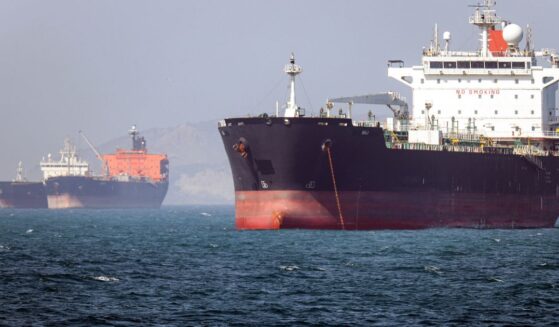
As noted by The Wall Street Journal, for most of the time during the war that began in February, Iran has used oil stored in a shadow fleet of tankers parked in Asian waters to maintain sales to Chinese buyers.
But as the oil was sold off without being replaced, the tankers emptied, and the billions in Chinese cash Iran needs to prop up its economy are no longer flowing.
“There’s no more oil to discharge to China anymore,” Homayoun Falakshahi, head of crude-oil analysis at Kpler, told The Wall Street Journal.
Iran’s shadow fleet oil reserve peaked at nearly 90 million barrels, but plummeted to less than 1 million barrels by Oct. 5, and is now hovering near nothing, according to Kpler.
U.S. Central Command estimated on Saturday that the blockade has cost Iran about $25 billion.
American military actions have “imposed devastating costs on Iran’s security apparatus,” Adm. Brad Cooper, head of U.S. Central Command, said.
Iran’s economy is on verge of collapse. Says @TheEconomist
Don’t relent @realDonaldTrump https://t.co/fhe9yqSS8W— Ujjaval Shah (@UJJAVALSHAH2) October 19, 2026
Although Iran has tried to use surface transportation to get some oil out of the country — and still receives revenue from past sales to China — the outlook is not good.
Falakshahi said between 30 percent and 40 percent of Iran’s revenue comes from oil sales. As inflation soars, the Iranian economy is reeling.
Fortune, for example, put the Iranian inflation rate at near 90 percent.
The outlet also reported that soldiers and government workers are not getting paid, which has sparked protests.
Shay Khatiri, a senior fellow at the Yorktown Institute, noted that there has been an uptick in domestic incidents expressing anger with the central government.
“As the Iranian regime weakens, the number of such local movements will likely multiply in number and consolidate in power,” he said.
“It looks like the U.S. gamble is that the economy will either push the regime back into negotiations to accept a nuclear deal, or will spark protests internally which the regime will face challenges containing,” Falakshahi said, according to The Wall Street Journal.
America’s pressure on Iran is WORKING.
The Islamic regime is withholding salaries, pensions, and benefits across its economy — and the IRGC isn’t even paying its own troops. https://t.co/bHNRcW8U1l
— House Republicans (@HouseGOP) October 20, 2026
Iran keeps on talking tough.
Abdolnaser Hemmati, the governor of Iran’s central bank, said that despite external pressure, “the Iranian economy has demonstrated very good resilience, and the claim that Iran’s economy is collapsing is nothing more than an illusion.”
Advertise with The Western Journal and reach millions of highly engaged readers, while supporting our work. Advertise Today.
Truth and Accuracy
We are committed to truth and accuracy in all of our journalism. Read our editorial standards.