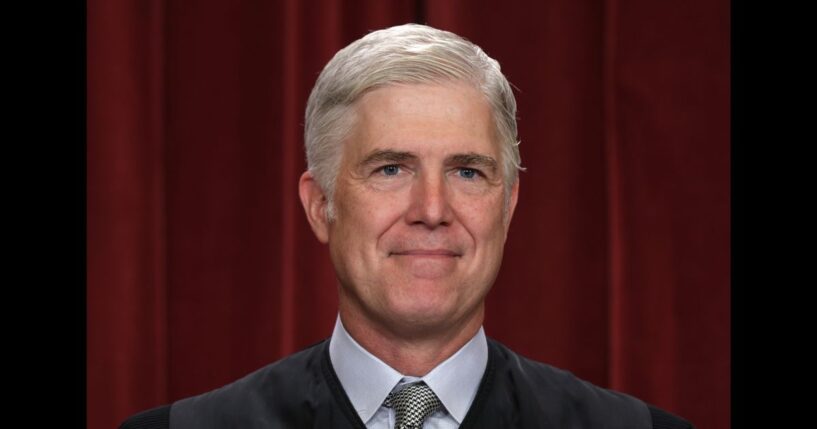
Listen: Justice Gorsuch Relentlessly Takes Apart Lawyer for Fired Bureaucrat Who Is Suing Trump - 'I Didn't Ask That'

Now, I may not be a legal eagle, but I’d like to think I know a thing or two — including that it’s never a good sign when your argument is that the president of the United States does not have an obligation to enforce the law, or that you can’t state your case in plain words.
In a viral clip from Monday’s oral arguments in what could be the biggest Supreme Court case of the term, Justice Neil Gorsuch railed against the attorney for fired Federal Trade Commission member Rebecca Slaughter and those who think that there’s a place in the “constitutional order” for a “fourth branch of government that’s quasi-judicial and quasi-legislative.”
The clip comes as a good reminder as to why the court should side with President Donald Trump in the case of Trump v. Slaughter, which seeks to overturn a 1935 landmark decision known as Humphrey’s Executor. In that case, the court ruled then-President Franklin D. Roosevelt could not fire an FTC commissioner for a reason aside from “inefficiency, neglect of duty, or malfeasance in office.”
That case has become the bane of judicial originalists, in part because it’s allowed that “quasi-judicial and quasi-legislative” order to take root to an extent which the framers would have never countenanced. The big news out of Capitol Hill on Monday was that the court was on the verge of striking the 1935 case down. Second-biggest, however, was the epic smackdown provided by Justice Gorsuch during an exchange with Slaughter attorney Amit Agarwal.
The exchange began with a basic back and forth about whether or not the defense viewed that the president was “vested with all the executive power” and then moved onto whether or not “he has a duty to faithfully execute all the laws.”
Agarwal said yes to both of these, but hedged on the second when Gorsuch followed up with, “Civil and criminal?”
“We — we agree that the Constitution imposes on the president a duty to faithfully execute the laws, absolutely,” Agarwal responded.
“All the laws?” Gorsuch asked. After Agarwal hedged, he asked “Are there some laws he doesn’t have to? That would be news to our friends across the street [in Congress].”
“The Take Care Clause is a duty, and it is also a power,” Agarwal said, referring to the section of Article II of the Constitution in which it says the executive must “take care that the laws be faithfully executed.”
“But the text of the clause does not proivide that the president must have at-will presidential–” Agarwal continued before he was cut off.
“I didn’t ask that,” Gorsuch said. “Does he have a duty to execute all the laws?”
“We know from–” Agarwal started.
“Yes or no?”
“I would say no, in the sense … there’s two different questions, and I just want to make sure that I’m answering the questions,” Agarwal responded.
“The question is, does the president have a duty to faithfully execute all the laws. The answer is no. Why?” Gorsuch followed on.
Agarwal went on to say that he believed “the president does not under both history and tradition have to have plenary power of supervision, but in the FTC, he does have some power of supervision, including if there’s a demonstrable, palpable violation of law.”
Gorsuch then asked about the potentiality for an FTC commissioner to commit unlawfulness, and Agarwal said that the president’s power didn’t extend to civil matters.
“Just to be clear, so that means if the government wants to bring a misdemeanor, that person has to be reportable to the president, but if the government wants to bring ruinous fines and penalties and injunctions, that person doesn’t?” Gorsuch asked. (Which, in case you’re just catching on, that’s what the FTC does.) Again, this didn’t go too far.
“I’ll put my cards on the table,” Gorsuch said during the exchange. “Maybe it’s a recognition that Humphrey’s Executor was poorly reasoned and that there is no such thing in our constitutional order as a fourth branch of government that’s quasi-judicial and quasi-legislative. Maybe you’re trying to back-fill it with a better new theory that itself recognizes that we’ve got a problem.”
🚨 EPIC: SCOTUS Justice Neil Gorsuch goes OFF on the rogue bureaucratic state at today’s oral argument, as the Court seems poised to hand Donald Trump a victory
“…there is no such THING in our constitutional order as a 4th branch of GOVERNMENT!” 🔥
“Maybe it’s a recognition… pic.twitter.com/Q8rr9plP3X
— Eric Daugherty (@EricLDaugh) December 8, 2025
Compare this to Biden’s sole contribution to the court, Justice Ketanji Brown Jackson. She used the occasion to remind us to spare a thought for the poor, unprotected Ph.Ds:
SCOTUS: Justice Ketanji Brown Jackson told the Court that presidents should not be able to fire the PhDs & experts who run the government. She even argued presidents should avoid control over transportation & the economy.
In a remarkable exchange in Trump v Slaughter, Justice… pic.twitter.com/sXQesOSdKG
— @amuse (@amuse) December 8, 2025
“My understanding was that independent agencies exist because Congress has decided that some issues, some matters, some areas should be handled in this way by nonpartisan experts, that Congress is saying that expertise matters with respect to aspects of the economy and transportation and the various independent agencies that we have,” Jackson said.
“So having a president come in and fire all the scientists and the doctors and the economists and the Ph.Ds and replacing them with loyalists and people who don’t know anything is actually not in the best interest of the citizens of the United States. This is what I think Congress’s policy decision is when it says that these certain agencies we’re not going to make directly accountable to the president.”
What’s the takeaway here, aside from the fact that Ketanji Brown Jackson remains a national treasure for all the wrong reasons?
Here’s the perfect encapsulation of conservative and liberal governing and judicial philosophy. On one side, believing that the Constitution is written how it’s written and that the president has authority over the executive branch. On the other side, a belief that we should defer to our academic betters even if Article II doesn’t say that we should, because, you know, the experts!
Again, I may not be a legal eagle — but I’m glad that we’ve had enough of Donald Trump as our president that we have the justices in place to support the first notion and overrule the second.
Truth and Accuracy
We are committed to truth and accuracy in all of our journalism. Read our editorial standards.
Advertise with The Western Journal and reach millions of highly engaged readers, while supporting our work. Advertise Today.