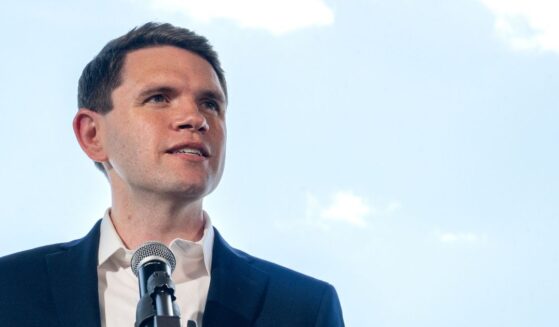
Marco Rubio Warns Iran's Strait of Hormuz Scheme Could 'Spread Throughout the World Like a Contagion'

Secretary of State Marco Rubio on Thursday warned that an Iranian scheme to collect money from shipping that uses the Strait of Hormuz would amount to a “contagion” that would endanger global navigation.
Rubio was in Bahrain — the headquarters of the U.S. Navy’s Fifth Fleet — on the same day the Iranian military attacked a cargo vessel transiting the strait.
In his speech, Rubio stressed that accepting the ability of Iran — or any nation — to exert extortionate control over international shipping would violate a “foundational principle” of freedom of the seas.
Marco Rubio on Iran:
Straits of Hormuz are international waters. International waterways do not belong to any nation-state. This is a foundational principle in the world today, without which the world would be in total chaos.
If, in fact, we accept that you can charge money to… pic.twitter.com/slCCqx8mAK
— Clash Report (@clashreport) June 25, 2026
“The Straits of Hormuz are international waters,” Rubio told members of the Gulf Cooperation Council, according to a State Department transcript. “International waterways do not belong to any nation-state. This is a foundational principle in the world today, without which the world would be in total chaos.”
Rubio said accepting that Iran could charge a toll for ships using the strait would “spread throughout the world like a contagion.”
“And then we’re going to have chaos,” he said. “So that is not acceptable.”
And such a situation won’t be part of any deal the U.S. reaches with Iran, he said.
US Secretary of State Marco Rubio responds to Iran’s attempts to normalize transit fees in the Strait of Hormuz:
“You can call it a toll, you can call it a fee—call it whatever you want. It is merely a matter of semantics.
The reality is that no country in the world has the… pic.twitter.com/zajNbb9TFf
— Eli Afriat 🇮🇱 (@EliAfriatISR) June 25, 2026
The Strait of Hormuz, which connects the Persian Gulf to the Gulf of Oman and the Red Sea, and global oil markets beyond, is a chokepoint for oil tankers leaving the Persian Gulf.
Iran has used its position on the north side of the strait to threaten shipping through the gulf, which has caused a large part of the rise in global oil prices since the U.S.-Israeli attacks on Iran began on Feb. 28.
Thursday’s attack on a Singapore-flagged vessel reinforced the danger of that threat.
Two weeks ago, the Islamic Republic proposed charging “fees” for shipping through the strait, The New York Times reported.
While noting that “tolls” would be illegal under international law, the newspaper explained that “fees” — money in exchange for services rendered — could be legal.
The report noted that Iran did not explain what services would be rendered. (Presumably, they would include not targeting paying customers with missiles from the Islamic Revolutionary Guard Corps.)
Rubio had no time for word games during his Bahrain speech.
“You can call it a ‘toll,’ you can call it a ‘fee,’” he said. “Whatever you want to call it, it’s a game of semantics.”
“The reality of it is that no country on Earth has a right to charge for the use of international waterways,” he continued.
“And that will never be an acceptable condition of any deal,” he said. “The president has been fundamentally clear about that.”
Advertise with The Western Journal and reach millions of highly engaged readers, while supporting our work. Advertise Today.
Truth and Accuracy
We are committed to truth and accuracy in all of our journalism. Read our editorial standards.