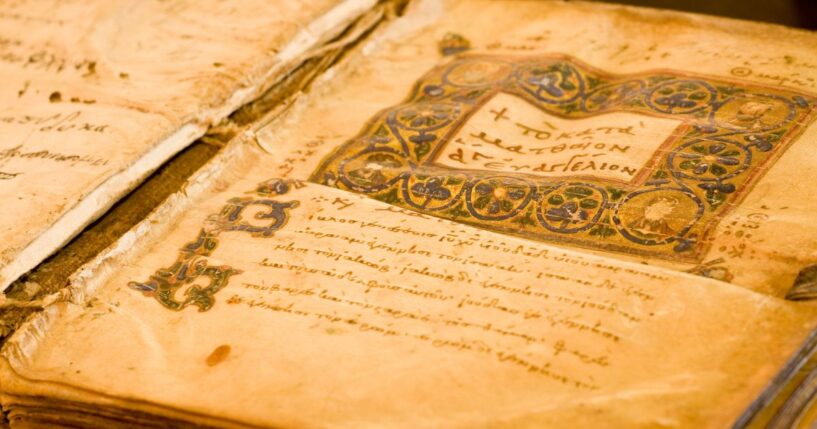
Research Team Reveals the Secret of Ancient Biblical Manuscript

A team of researchers successfully pieced together 42 pages of a manuscript from a document containing copies of the apostle Paul’s letters.
Professor Garrick Allen from the University of Glasgow led a team of international academics to recovering the pages from Codex H, an anthology of Paul’s letters dating to the 6th century, according to an April 24 announcement from the school.
Codex H was disassembled at at the Great Lavra Monastery on Mount Athos, Greece, sometime in the 13th century.
The pages were then reused as binding material for other manuscripts.
But Allen’s team discovered that the 42 pages from the document included ancient chapter lists, scribal insights, and medieval recyclings.
An international team of academics led by Grantee Garrick Allen of @UofGlasgow has successfully recovered 42 lost pages from one of the world’s most important early New Testament manuscripts: Codex H. https://t.co/tVwv8LF0LV
— Templeton Religion Trust (@TempletonRelig) April 27, 2026
“The breakthrough came from an important starting point: we knew that at one point, the manuscript was re-inked,” Allen explained in the announcement.
“The chemicals in the new ink caused ‘offset’ damage to facing pages, essentially creating a mirror image of the text on the opposite leaf — sometimes leaving traces several pages deep, barely visible to the naked eye but very clear with latest imaging techniques.”
The researchers used “multispectral imaging to process images of the extant pages, in order to recover ‘ghost’ text that no longer physically exists, effectively retrieving multiple pages of information from every single physical page.”
To make sure the findings were accurate, more researchers based in Paris used radiocarbon dating to ensure the pages originated from the 6th century.
Other pieces of Codex H are also scattered across Italy, Greece, Russia, Ukraine, and France.
A codex is a type of book made of bound vellum, papyrus, or parchment. Codex H is indeed made of parchment, which is processed animal skin.
The announcement noted that the chapter lists of Paul’s letters “differ drastically from how we divide these letters today,” and are the earliest known examples of such chapter lists.
The scribal insights meanwhile “show how 6th-century scribes corrected, annotated and interacted with sacred texts.”
The Great Lavra Monastery on Mount Athos was credited with helping the project.
The Bible, including the New Testament, is one of the best preserved documents from antiquity.
There are roughly 6,000 early manuscripts of the New Testament that still exist today, according to the Institute for Creation Research.
Advertise with The Western Journal and reach millions of highly engaged readers, while supporting our work. Advertise Today.
Truth and Accuracy
We are committed to truth and accuracy in all of our journalism. Read our editorial standards.