Text Messages Between Cornell Jane Doe and Alleged Attacker Turn Case on Its Head

It’s not so much a case of he said/she said as it is “she said then” and “is saying now.”
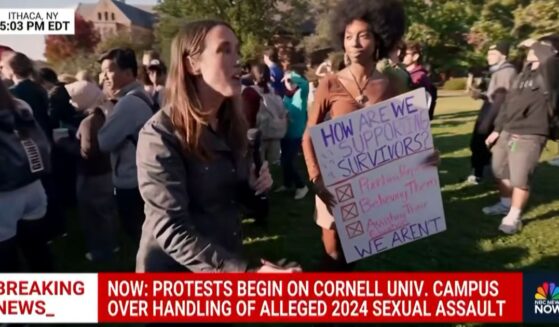
With liberals braying for fraternity brothers’ blood, and the state of New York swinging into hanging-judge action, the high-profile case of an alleged rape at a Cornell University fraternity house could well boil down to the victims’ own words.
And those words could sink any serious criminal action against the accused — even if leftist politics try to keep it afloat.
As most of the country has learned over the past week, a young woman who attended Cornell in 2024 has filed a civil suit against the university, the Chi Phi fraternity and a local bar where she’d reportedly been drinking illegally in connection with a sexual incident involving the woman and a group of Chi Phi brothers.
New York Gov. Kathy Hochul has involved herself in the case via executive order, taking it out of the hands of the Tomkins County District Attorney’s Office and appointing a special prosecutor.
The special prosecutor is New York Attorney General Letitia James, a woman who not only established a national reputation for politically driven pursuit of President Donald Trump, but who has also already made public her far-from-impartial opinion about the guilt of the accused in the Cornell case.
But text conversations between the woman — unidentified other than the alias “Jane Doe” — and two of the men she accused — Jonathan Newell and Matthew Ingalls — show just how cloudy a criminal case is going to be, three years after the event began on Oct. 19, 2024.
“At the end of the day non of the sexual stuff was illegal and honestly i really liked being w u and matt,” she wrote to Newell in an Oct. 21, 2024, text, according to a New York Times report Friday.
This text message alone, from Jane Doe to one of the Cornell 7, send just 2 days after the alleged SA renders any prosecution inviable https://t.co/Cx1AmUXWJF
— Phil Holloway (@PhilHollowayEsq) October 2, 2026
“This text message alone, from Jane Doe to one of the Cornell 7, send just 2 days after the alleged SA renders any prosecution inviable,” Fox News legal analyst Phil Holloway wrote in a post on the social media platform X.
And that wasn’t all.
In The New York Times report, the woman is described as becoming increasingly dismayed in the days after the event — particularly as word about it began to spread on campus.
However, she was still “eager” to attend a Halloween party at the very same fraternity house, according to the report.
“Text messages included in the investigation show Mr. Ingalls assuring Jane Doe that he and other fraternity members wanted her to be there,” The New York Times reported.
Supposedly relaying the views of the fraternity president, Ingalls texted the woman that “chi phi is your house and you are welcome here,” according to the report.
The woman responded: “thank u i really appreciate that. <3 i’ll bring my cigs tomorrow.”(For readers who grew up using rotary phones, the “<3” is text slang, indicating a heart shape, albeit sideways.)
But the invitation was rescinded by the fraternity’s president — who is not accused in the case.
He told her it was for her own good, according to the report. And she took that badly.
“I knew this was going to happen,” she wrote in text to Ingalls. “The woman will always get the short end of the stick. Yall aren’t my friends. Yall are covering your asses.”
Then the New York Times report included an understated segue:
“By Nov. 3, Jane Doe appears to have concluded that she was assaulted at the October party.” [Emphasis added.]
So, it wasn’t really a sexual assault until Nov. 3? Days after the alleged victim had been disinvited from a Halloween party she was eager to attend at the same location with the same people where she was supposedly raped less than two weeks earlier?
By the time the young woman did give a statement to the Cornell Police Department (the campus police), it was Nov. 8, according to USA Today, more than three weeks after the incident (but only a week after Halloween).
A six-page summary of her interview with the police — a summary Doe signed off on — was provided to the district attorney’s office, which declined to bring criminal rape charges based on the fact that the woman had described her actions as “voluntary, conscious, and consensual,” USA Today reported.
She was obviously understandably unhappy with the results, but criminal law is criminal law, not a therapy session for sorority sisters.
Could any prosecutor in good conscience attempt to bring a criminal case based on this kind of context? The answer, of course, is “no.” But we’re not talking about a prosecutor with a conscience. We’re talking about New York Attorney General Letitia James, who has a demonstrated record of warping the law for her own political purposes.
None of this is to defend the men who are accused in the case — and could well face at least the potential for severe criminal penalties. By all accounts, they behaved appallingly. Some were expelled from Cornell as a result of the event. Some were suspended.
(The woman reportedly left the university on her own.)
It is a question of how far liberals are willing to twist the law in the service of politics.
Decent men and women can feel sympathy for this young woman but be disgusted by her behavior.
Decent men and women can be disgusted by the behavior of the men, but still oppose the abuse of criminal law because liberals want another soapbox to jump on. (New York Rep. Alexandria Ocasio-Cortez, for instance, has weighed in, in utterly predictable fashion.)
The woman’s texts from the days after the incident tell the real story of what happened here.
In “what she said” versus “what she’s saying now,” it’s the “what she said” that sounds a lot more believable.
Advertise with The Western Journal and reach millions of highly engaged readers, while supporting our work. Advertise Today.
Truth and Accuracy
We are committed to truth and accuracy in all of our journalism. Read our editorial standards.