Bank of America and JPMorgan Chase Consider Teaming Up for Scheme to Extract Higher Card Transaction Fees

There could be a major battle brewing between banks, regulators, and merchants.
And caught in the middle of all that might very well be you, the paying customer.
The Wall Street Journal put out a blistering report on Monday highlighting that one bank’s unexpected discovery of a potential loophole has other banks considering that same loophole.
In 2025, Capital One Financial purchased Discover Financial for $50.6 billion.
As part of that acquisition, Capital One gained a financial network that allows it to work more directly with merchants — and with less fear of regulation.
To better explain how this works: When you make a purchase at, say, a Walmart, there are actually three parties that are going to have an interest when you swipe your debit card.
In this case, those parties are Walmart, the bank that issued your debit card, and a payment network — Visa and Mastercard being the two you’ve most likely dealt with.
Of note, neither Visa nor Mastercard is lending or handling any money here. They act almost exclusively as an information network that verifies with the bank that you have the money you’re trying to spend.
Once that is confirmed, the charge is approved, and Walmart gets their money. But, while Walmart will receive most of the money you spent, a small bit of that will be split between the bank and the payment network, with the bank typically receiving the bigger share because it issued that card.
That small cut of what’s otherwise Walmart’s money is what’s known as an interchange fee, which is what the merchant (Walmart, in this example) is basically paying for the convenience of accepting debit cards.
Given how many debit card swipes happen across the country at a given time, it’s little wonder that banks typically love this interchange fee — while merchants loathe it.
As debit card use continues to explode in popularity, Congress actually intervened in 2010 to pass the Durbin amendment as part of the broader Dodd-Frank Wall Street Reform and Consumer Protection Act.
The Durbin Amendment effectively hard caps how much banks can charge for that interchange fee.
However, The Wall Street Journal is reporting that there effectively appears to be a loophole to the Durbin amendment, which the Capital One acquisition of Discover yielded.
In short, the Durbin amendment only really applies to third-party payment networks, like Visa and Mastercard. But Capital One doesn’t appear to be beholden to those regulations because Discover’s payment network is theirs outright after the purchase.
That means that Capital One could, in theory, start charging merchants whatever they want as an interchange fee.
And if those costs get too exorbitant for the merchant, they could get passed down to the consumer — which may be exactly why major banks have yet to pull the trigger on making a move to acquire their own payment networks.
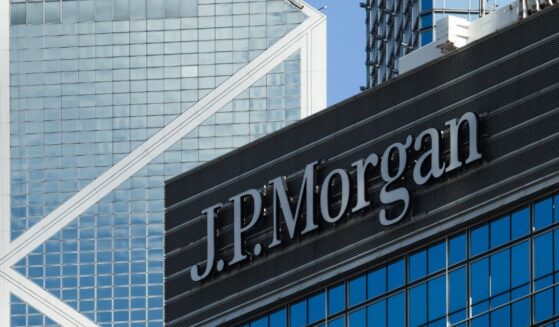
According to The Wall Street Journal, major banks like JPMorgan Chase, Bank of America, Wells Fargo, and PNC Financial Services Group “have been exploring a small deal that could upend the rules, though they are worried about political backlash if they try.”
Talks are still being described as “preliminary and tentative” about whether or not to purchase a payment network from Fiserv.
The outlet added, “Some have privately expressed concern that such a deal could prompt backlash from lawmakers, regulators and merchants.”
Importantly, due to the potentially volatile optics of uniting both Democrats and Republicans against a common foe, “there is no certainty a deal will happen,” The Wall Street Journal reported.
Advertise with The Western Journal and reach millions of highly engaged readers, while supporting our work. Advertise Today.
Truth and Accuracy
We are committed to truth and accuracy in all of our journalism. Read our editorial standards.