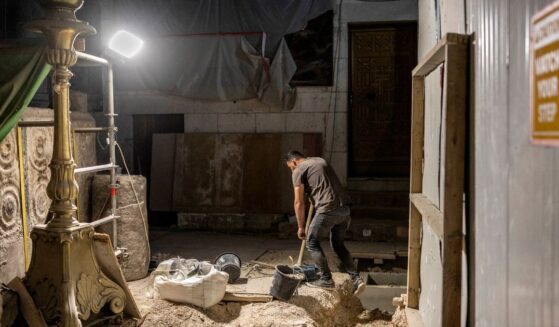
Excavation at Traditional Site of Jesus' Tomb Uncovers Details Consistent with Scripture

Archeologists have concluded that a site in Jerusalem, traditionally believed to be the location of Jesus’ burial tomb, meets all of the descriptors given in the Bible.
Lead archaeologist Francesca Romana Stasolla of the “La Sapienza” University of Rome told the Daily Mail, “We have found evidence of a funerary landscape.”
The news outlet reported, “For nearly 1,700 years, Christians have believed that [the] tomb lies within Jerusalem’s Church of the Holy Sepulchre.”
“The first church was built over the site by Roman Emperor Constantine in the fourth century, and generations of pilgrims have since traveled there to pray where Christ is believed to have been crucified, buried and resurrected,” the Daily Mail said.
Researchers have recently completed excavations in the church compound, concluding what they’ve found is consistent with the biblical account.
John 19:41-42 reads: “Now in the place where he was crucified there was a garden, and in the garden a new tomb in which no one had yet been laid. So because of the Jewish day of Preparation, since the tomb was close at hand, they laid Jesus there.”
For decades the Garden Tomb attracted tourists as the site of Jesus’ crucifixion and burial. But the tombs there don’t date to the 1st century AD. The traditional site, the Church of the Holy Sepulchre, matches all the biblical details, and this excavation is in the “right spot.” https://t.co/uZXBCBlDIY pic.twitter.com/shCO9m2BvE
— Dinesh D’Souza (@DineshDSouza) August 28, 2026
Further, Hebrews 13:12 tells us that Jesus was crucified outside the city gates of Jerusalem.
The Church of the Holy Sepulchre meets all of these criteria, containing both the traditional site of Jesus’ crucifixion and a garden tomb close at hand, as researchers detailed in a new 98-page preliminary report published in Liber Annuus, the archaeological journal of Jerusalem’s Studium Biblicum Franciscanum.
Stasolla told The Times of Israel, “The gospel mentions a green area between the Calvary and the tomb, and we identified these cultivated fields,” noting the discovery of pollen from olive trees and grapevines at the excavation location.
The archeologist further revealed, “The church stands on a quarry, which does not surprise us because a vast part of the Old City of Jerusalem stands on a quarry.”
“The quarry was already active in the Iron Age. During the excavation, we found pottery, lamps, and other everyday objects dating back to that period.”
The traditional tomb of Jesus lies inside the Church of the Holy Sepulchre in Jerusalem, a site honored by Christians as the place of both his crucifixion and burial.
Although not conclusively proven, archaeological findings and centuries of Christian tradition point to this… pic.twitter.com/vD6FyAugX7
— Fascinating (@fasc1nate) August 29, 2026
“We need to imagine that as the quarry was progressively abandoned, tombs were carved at different levels,” Stasolla said. “The area, therefore, featured several burials from that period. Constantine selected the one that had been venerated as the tomb where Jesus was buried, and he excavated around it in the area that corresponds to the current rotunda, isolating it from the other burials.”
The Times of Israel reported, “Several other tombs are known as part of the Holy Sepulchre compound, including one that Christian tradition attributes to Joseph of Arimathea, who is said to have gifted Jesus his empty burial plot.”
Earlier this year, a geological study published over a decade ago, which concluded that an earthquake occurred in ancient Israel around the time of Jesus’ crucifixion, resurfaced in a viral social media post.
The study’s finding, published in International Geology Review in 2012, is consistent with the biblical account, which said an earthquake occurred immediately after Jesus’ death.
The apostle Matthew wrote in chapter 27 of his Gospel that darkness covered the land starting at midday, as Jesus hung on the cross, and that this phenomenon lasted for the next three hours.
Then, around 3:00 p.m., “Jesus cried out with a loud voice, saying, ‘Eli, Eli, lema sabachthani?’ that is, ‘My God, my God, why have you forsaken me?’”
Soon thereafter, Jesus “cried out again with a loud voice and yielded up his spirit.”
“And behold, the curtain of the temple [in Jerusalem] was torn in two, from top to bottom. And the earth shook, and the rocks were split. The tombs also were opened. And many bodies of the saints who had fallen asleep were raised, and coming out of the tombs after his resurrection they went into the holy city and appeared to many,” Matthew wrote.
“When the centurion and those who were with him, keeping watch over Jesus, saw the earthquake and what took place, they were filled with awe and said, ‘Truly this was the Son of God!’”
SCIENCE (ONCE AGAIN) CONFIRMS THE BIBLE™️ AS A TRUE ACCOUNT🇻🇦
The Bible says there was a great earthquake when Jesus died on the cross (Matthew 27:50‑54). Now, scientists have found real evidence that this happened.
A group of geologists studied the ground near the Dead Sea and… pic.twitter.com/i941plPplx
— ☩ 𝕁𝕄𝕋 ☩ (@SecretFire79) February 25, 2026
Many historians point to Friday, April 3, A.D. 33, as the likely date of Jesus’ execution.
Advertise with The Western Journal and reach millions of highly engaged readers, while supporting our work. Advertise Today.
Truth and Accuracy
We are committed to truth and accuracy in all of our journalism. Read our editorial standards.