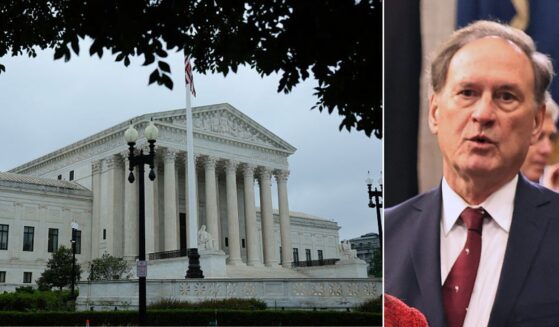
Supreme Court Delivers Big 2nd Amendment Win, Striking Down Restrictive Concealed Carry Law

The Supreme Court on Thursday struck down a Hawaii law that banned gun owners from carrying their weapons on privately owned property that is open to the public unless they had the owner’s consent.
“The restrictions imposed by Hawaii’s challenged law fall within the plain text of the Second Amendment, so the law is presumptively unconstitutional,” the majority opinion written by Justice Samuel Alito said.
“No party disputes that petitioners are among ‘the people’ protected by the Second Amendment or that they seek to ‘bear’ ‘Arms.’ Therefore, ‘the plain text of the Second Amendment protects’ what petitioners want to do: carry handguns for self-defense,” he wrote in the 6-3 ruling in the case of Wolford v. Lopez.
“The law is presumptively unconstitutional,” he wrote.
Alito wrote that the law “hobbles what the Second Amendment protects: the right of Americans to carry arms for self-defense as they go about their daily lives.”
BREAKING: The U.S. Supreme Court has struck down a Hawaii law in a 6-3 ruling that barred people with concealed-carry permits from bringing firearms onto private property open to the public — such as stores, restaurants, hotels, malls, and gas stations — unless the property owner… pic.twitter.com/puREcKLnJV
— RedWave Press (@RedWavePress) June 25, 2026
Chief Justice John Roberts and Justices Clarence Thomas, Neil Gorsuch, Brett Kavanaugh, and Amy Coney Barrett joined Alito. Justices Ketanji Brown Jackson, Sonia Sotomayor, and Elena Kagan dissented.
In a concurring opinion, Barrett said banning guns because they are unpopular is not a sufficient reason under the terms of the Second Amendment.
She further noted that the issue at hand is not whether a property owner can decide to ban guns, but whether a state can pass a law banning guns on privately owned properties where the public is allowed.
🚨 BREAKING: The U.S. Supreme Court just struck down Hawaii’s “private property default rule” law in a 6-3 decision, delivering a massive win for the Second Amendment.
This unconstitutional law prevented gun owners from carrying their firearms in public places without express… pic.twitter.com/SNeb4hjc4U
— NRA (@NRA) June 25, 2026
Barrett wrote that “the rule does not target any particular abuse of firearms at all. Rather than identifying a specific threat to public peace and safety, Hawaii admits that it enacted the rule because many of its citizens oppose the public carry of guns.”
“In other words, Hawaii is responding to the general danger associated with the presence of firearms, not to any specific, heightened risk of their misuse,” she wrote.
The Supreme Court by a 6 to 3 decision strikes down Hawaii’s regulations restricting concealed carry.
Barrett in concurrence has this powerful zinger: “What if a State made it a crime to wear religious head garb (say, a hijab) onto private property open to the public without…— John R Lott Jr. (@JohnRLottJr) June 25, 2026
“While most Hawaiians might prefer that no one carry firearms in public places, a majority’s opposition to a constitutional right is not a permissible basis for restricting it,” she wrote.
“After all, ‘[t]he very purpose of a Bill of Rights was to withdraw certain subjects from the vicissitudes of political controversy’ and ‘to place them beyond the reach of majorities and officials,’” she wrote.
BREAKING: Supreme Court bolsters right to carry by voiding Hawaii gun law. pic.twitter.com/9425qwKVMp
— Bloomberg Law (@BLaw) June 25, 2026
In her opinion, Barrett further noted that a state law to ban guns brought onto private property is as much a violation of the Second Amendment as a ban on hijabs worn on private property would be a violation of the First Amendment.
As noted by Scotusblog, the ruling is likely to impact California, Maryland, New York, and New Jersey, which have similar laws.
Advertise with The Western Journal and reach millions of highly engaged readers, while supporting our work. Advertise Today.
Truth and Accuracy
We are committed to truth and accuracy in all of our journalism. Read our editorial standards.