Is AI Making Us Dumb?

A recent NPR/IPSOS survey of K–12 teachers found that 54 percent of teachers believe AI is making it harder for students to develop critical thinking skills.
Forty percent said AI has had a negative effect on education. Only 9 percent called the effect positive.
These are not politicians offering opinions. These are the teachers in the classroom with our children every day.
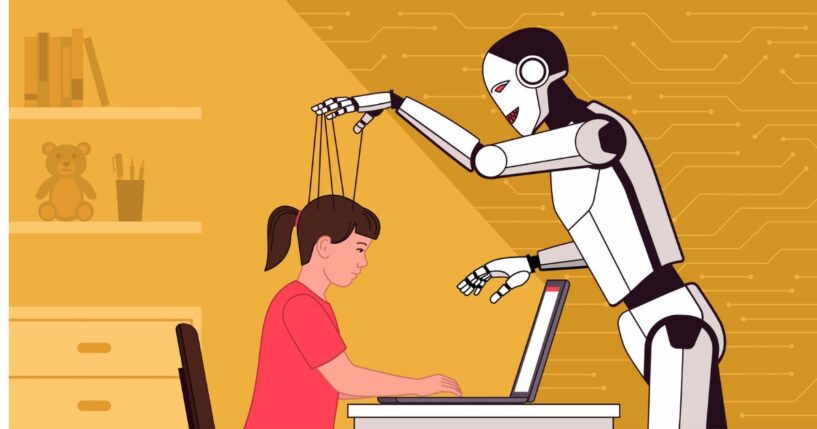
And what they are watching is a generation slowly outsourcing its mind.
The survey findings go beyond critical thinking. Fifty-seven percent of teachers said AI makes it harder to assess what students actually know. Fifty-nine percent said it is eroding trust between teachers and their students — the foundational relationship that learning depends on.
That last number deserves to land. When a student submits work that is not their own, something more than academic integrity is compromised. The teacher can no longer know the student. The student can no longer know themselves. Learning becomes theater.
To understand the stakes, it helps to be specific.
Writing is thinking. When a student wrestles with how to organize an argument, find the right word, discard what does not work, and start again, they are not just producing a document. They are training their mind to structure reality. AI removes that friction entirely. The result looks like thought, but required none.
Reading is a workout. The effort of sitting with a difficult text — rereading, inferring meaning, connecting ideas to what you already know — is how the brain builds durable understanding. Students who use AI to summarize everything they read are skipping the exercise. The muscles do not develop.
Memory is not storage — it is a skill. Cognitive science has established for decades that retrieving information from your own mind strengthens both the memory and the neural pathways surrounding it. When students outsource recall to AI, they do not merely forget facts. They fail to build the mental architecture that makes wisdom possible.
Evaluating sources is becoming a lost art. Learning to distinguish a trustworthy claim from a dubious one, to weigh evidence, and to form independent conclusions is not a minor academic skill. It is the foundation of self-governance. People who cannot evaluate information are not prepared for democracy.
Human communication is forged through practice. Children who turn to a machine for help navigating conflict, processing emotion, or finding words for what they feel — rather than working through those things with real people –are being quietly deprived of what makes us human. That loss does not show up on a test. But it accumulates.
It would be naive to discuss AI in schools without asking who is paying for its implementation. Anthropic, Microsoft, and OpenAI gave millions of dollars to teachers’ unions last October to promote AI training, according to the Associated Press.
Goldman Sachs projects Big Tech will spend $5.3 trillion on AI between fiscal years 2025 and 2030.
These companies have an obvious financial interest in reaching the youngest and most impressionable users first.
That does not make every classroom AI application wrong. But it means parents and legislators should ask hard questions about who is shaping the guidance handed to teachers — and what those funders stand to gain.
A generation that cannot write clearly will struggle to persuade, negotiate, or lead. A generation that cannot think critically will be easily manipulated. A generation that cannot sit with difficulty — a hard text, a failed argument, an unanswered question — will lack the resilience that any meaningful work requires.
There is also something more subjective that atrophies inside us: the capacity to reason through a problem without reaching for help, to stay in uncertainty long enough to arrive at your own answer, to think a thought that is genuinely yours.
If we raise children who have never had to find their own words or fight through their own confusion, we should not be surprised when they grow into adults who cannot.
Kansas has led before on education. We can lead again — by demanding clear guidance on AI in classrooms, by insisting that assessments measure what students actually know, and by remembering that the purpose of education is not efficiency.
The children in our classrooms today will govern, build, and lead this state in years to come. What kind of minds we give them is not a question we can afford to leave to Silicon Valley.
The views expressed in this opinion article are those of their author and are not necessarily either shared or endorsed by the owners of this website. If you are interested in contributing an Op-Ed to The Western Journal, you can learn about our submission guidelines and process here.
Advertise with The Western Journal and reach millions of highly engaged readers, while supporting our work. Advertise Today.
Truth and Accuracy
We are committed to truth and accuracy in all of our journalism. Read our editorial standards.