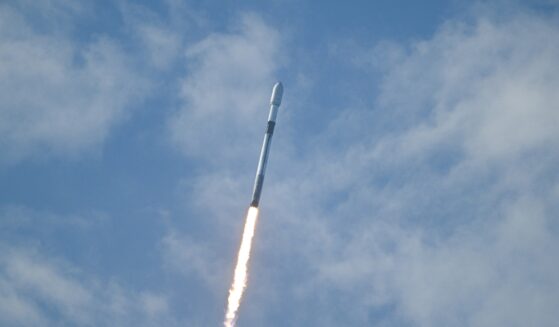
SpaceX Rocket Collides with Moon at 5,400 MPH

A SpaceX rocket booster slammed into the moon early Wednesday.
The 8,800-pound Falcon 9 rocket booster had been floating about in space since January 2025, according to CBS News.
The 45-foot-long booster rocket hit the moon at about 2:35 a.m. Wednesday while going 5,400 mph.
“Because the moon has no atmosphere to slow incoming objects, it is struck by meteoroids daily,” NASA noted in a post on its website.
NASA Administrator Jared Isaacman on rockets crashing into the moon: “It’s not a big deal right now. The moon has clearly seen better days.” pic.twitter.com/IiNt7PdM2V
— Aaron Rupar (@atrupar) August 5, 2026
“The rocket stage is expected to create a crater about 60 feet wide and 12 feet deep and throw dust and rock outward as ejecta,” NASA wrote.
“For comparison, a meteoroid with the same energy as the upper stage hits the Moon about every six days, so the lunar surface is constantly absorbing impacts with the same force,” the post said.
“Despite the disturbance, observing impacts gives scientists valuable insight by revealing how ejecta plumes behave, helping to understand the Moon’s geology and refine models that guide future exploration and science missions,” the post said.
A few hours ago… very early Wednesday morning an upper stage of a falcon 9 SpaceX rocket left over from a 2025 launch crashed into our moon. It was ~size of a school bus & ~ 4 tons. It was traveling ~5,400 mph. No real video as of yet is showing good details at time of impact.… pic.twitter.com/3jPiVMlwbl
— North_ (@North_1982) August 5, 2026
Although the impact was too far away and too small to be seen, Carl Schmidt, a planetary scientist at Boston University’s Center for Space Physics, said a plume of sodium and lithium gas was observed by the Very Large Telescope in Chile, suggesting that the impact took place as expected, per CBS News.
Schmidt said that he believes analyzing that data will help determine how much water ice was below the surface at the impact site.
A study about the booster’s collision with the moon estimated the impact would have the force of about 2.8 tons of TNT.
A spent SpaceX rocket stage is about to slam into the moon, and scientists are lining up to study the impact.
Most companies create press releases.
Elon Musk creates craters on another world. pic.twitter.com/TlimkxFp4E
— Gunther Eagleman™ (@GuntherEagleman) August 4, 2026
NASA said that it hopes to take before-and-after images of the rare impact of a man-made object with the moon with the Lunar Reconnaissance Orbiter, but indicated it might be a week before those images arrive on Earth.
“What has happened is essentially a mixture of solar activity and gravity forces have put it on a path toward the moon,” Julianna Scheiman, SpaceX director of NASA science and Dragon programs, said Monday, according to Reuters.
FYI, until we have some sort of continuous human presence on the moon, spacecraft crashing into it is extremely beneficial for science and not harmful whatsoever. Derelict spacecraft gouging a small crater in a sterile planetary body is a non-issue. It’s also been happening for…
— Andrew McCarthy (@AJamesMcCarthy) August 5, 2026
“This may be of some — probably minor — scientific interest, and we may learn some things from it,” Bill Gray, a creator of widely used astronomy software, said.
Advertise with The Western Journal and reach millions of highly engaged readers, while supporting our work. Advertise Today.
Truth and Accuracy
We are committed to truth and accuracy in all of our journalism. Read our editorial standards.